




Definition
Anti‑static polyurethane refers to cast polyurethane elastomers formulated to prevent static charge buildup and to safely dissipate electrostatic discharge (ESD). Unlike insulating elastomers, anti‑static PU contains conductive or dissipative additives such as carbon black, conductive polymers, metal flakes, or engineered fillers like graphene in order to lower surface and volume resistivity to targeted ranges that meet specific industry ESD requirements.
Typical industry targets:
- Surface resistivity (sheet resistance): commonly tuned to the dissipative range of 10^5 to 10^9 ohms/square.
- Volume resistivity: often engineered between 10^3 and 10^9 ohm·cm depending on filler loading and requirements.
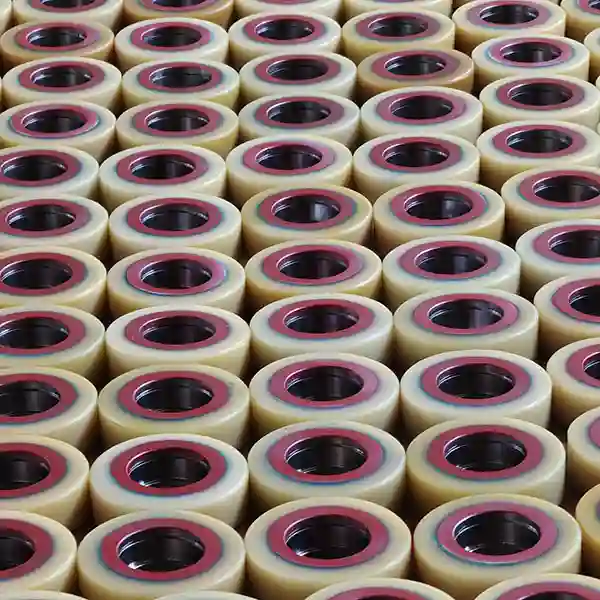
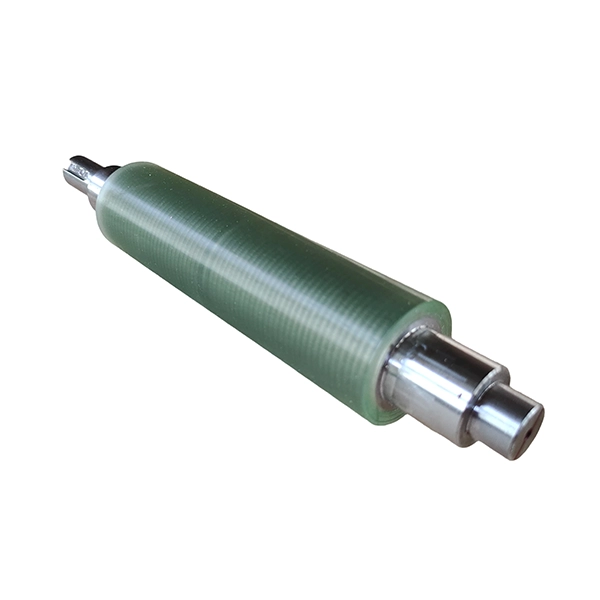
Anti‑static polyurethane can be produced as cast parts (hot or cold pour) to create complex geometries, bonded treads, rollers, wheels, seals, gaskets, and liners. “Custom cast anti‑static polyurethane parts” are widely requested for mecanum conveyor rollers, skid wheels, drive tires, stators/rotors, and machine mounts where static control is critical.
In procurement terms, buyers ask about price, material parameters (Shore hardness, resistivity, tensile strength), sample availability, lead time, and after‑sales service or local agent support. As a custom manufacturer, PEPSEN offers clear datasheets (resistivity test method, hardness, abrasion index) and sample parts for onsite evaluation is critical to win projects in automotive, electronics, and flammable‑environment applications.

Key Properties and Parameters
Anti‑static PU formulations are widely used across mechanical and electrical performance metrics. Typical parameters include:
- Hardness: 20A to 90D (Shore) for cast elastomers; urethane can be formulated to provide higher Shore D equivalents for specific applications.
- Tensile strength: 8–50 MPa depending on chemistry and filler content.
- Elongation at break: 150–800% (formulations with heavy conductive loading may reduce elongation).
- Abrasion resistance: generally superior to natural rubber; often specified by volume loss per ASTM D5963.
- Surface resistivity: tuned between 10^5 and 10^9 ohms/sq for ESD dissipative behavior.
- Volume resistivity: ranges from 10^3 to 10^9 ohm·cm; conductive grades aim lower, dissipative grades higher.
- Operating temperature: typical continuous range −40°C to +100°C; specialized systems reach higher heat tolerance for ovens or high‑temperature environments.
- Chemical resistance: good resistance to oils, greases, solvents, and flotation reagents depending on the base chemistry (TDI/MDI/NDI/PPDI/HDI/XDI systems).
- Bonding: excellent adhesion to metal cores (steel, aluminum) when correct bonding agent and process are used.
Testing and compliance: Surface resistivity and volume resistivity per ASTM D257, ESD performance per IEC 61340 series, and mechanical tests per ASTM D412/D2240 are common requests. Buyers should request measured parameters on actual samples (not just theoretical values) to validate performance in their environment.

Multi‑Scenario Applications by Industry
Anti‑static polyurethane is valuable wherever static buildup risks product damage, sparks, or dust attraction, and where mechanical durability is also required. Below are industry‑specific examples of typical applications.
Automotive
- Skid conveyor rollers and drive wheels in body‑in‑white and paint shop lines require ESD protection to avoid dust attraction during painting and to protect electronics. Anti‑static polyurethane skid wheels, drive tires, and conveyor idlers reduce static while delivering high load capacity and chemical resistance to paints and solvents.
Material handling & Warehousing Logistics
- Conveyors handling electronic components, battery packs, or sensitive modules demand ESD‑dissipative rollers and accumulation wheels. Anti‑static polyurethane rollers and guide wheels prevent charge buildup on pallets and skids; solutions include custom cast anti‑static rollers and replaceable treads for belt conveyors and roller conveyors.
Automation & Robotics
- AGV/AMR wheels, robotic end‑effectors, and gripper pads benefit from ESD materials when handling PCBs, batteries, or sensitive assemblies. Conductive urethane rollers for Omni and mecanum wheels improve traction and dissipate charge to protect onboard electronics.
Mining & Quarrying
- While heavy mineral processing is not traditionally focused on ESD, explosive dust environments and conveyor dust clouds in some mines benefit from anti‑static components to reduce ignition risk. Anti‑static conveyor idler wheels and chutes can be specified for hazardous areas.
Oil & Gas
- Offshore platforms and refineries operate in potentially flammable atmospheres; explosion‑mitigating equipment guidelines often require conductive/dissipative materials for moving parts that could generate charges. Anti‑static polyurethane linings, seals, and rollers are useful in processing and transfer systems.
Paper & Pulp
- Rollers and press components in paper machines often accumulate static causing web breakage or dust attraction. Anti‑static PU coatings and rollers help maintain smooth web handling and reduce defects.
Maritime & Shipping
- Deck roller systems, winch rollers, and cargo handling equipment can use anti‑static PU where silica or combustible dusts are present or where sensitive electronics are transferred.
Power Transmission & Machinery
- Couplings, timing belt rollers, and machine mounts in manufacturing lines that handle electronic assemblies or combustible powders benefit from ESD‑dissipative elastomers to prevent static accumulation.
Common scenarios: “anti‑static polyurethane wheels for warehouse”, “custom cast anti‑static rollers for automotive paint shop”, “ESD conductive polyurethane parts for AGV wheels”, and similar long‑tail search phrases are used by purchasing teams when evaluating suppliers.
Comparison with Competing Materials
Key competitors include conductive rubber (carbon‑filled elastomers), conductive thermoplastics (TPU with conductive fillers), conductive coatings, and metal components. Below is a brief comparison to help engineers select the best option.
Anti‑static polyurethane vs. conductive rubber
- PU typically offers higher abrasion resistance, superior load‑bearing, and longer life under cyclic loads. Carbon filled rubber may be more elastomeric at lower hardnesses, but PU can be tuned for higher hardness and better wear life. PU can be more dimensionally stable and bond better to metal cores for cast parts.
Anti‑static polyurethane vs. conductive thermoplastics (TPU)
- Thermoplastic conductive grades enable injection molding, beneficial for high‑volume small parts. Cast PU provides better abrasion resistance and custom large part capability (rollers, wheels). Cast PU also allows thicker parts and superior bonding for metal inserts.
Anti‑static polyurethane vs. metal/grounding systems
- Metal rollers and grounding straps provide direct conduction but can be heavy, noisy, and cause damage to conveyed goods. Anti‑static PU provides both mechanical cushioning and controlled dissipation without direct metal contact, useful for fragile or coated surfaces.
Anti‑static polyurethane vs. anti‑static coatings
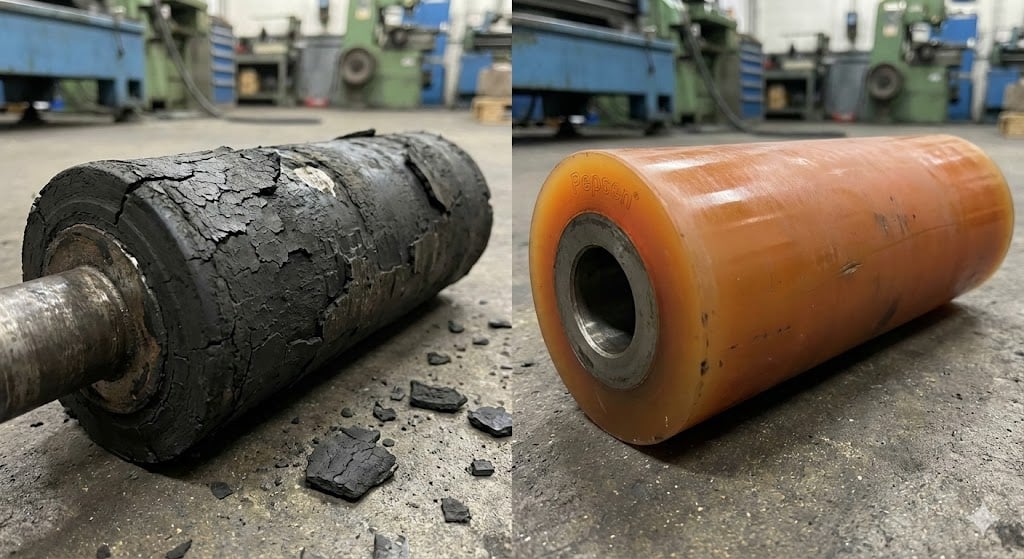
- Coatings can retrofit existing parts but wear off and require reapplication. Cast anti‑static polyurethane delivers bulk, durable conductivity that survives abrasive service, reducing maintenance and replacement frequency.
Trade‑offs: achieving low resistivity often requires higher filler loading that can reduce elasticity and raise price. Design teams must balance electrical parameters against mechanical demands and consider lifecycle cost (price per lifetime) rather than initial unit price alone.
FAQ
Q1: What surface and volume resistivity should I request for my application?
A: For ESD control in electronics and automotive assembly you typically target surface resistivity in the dissipative range, 10^6–10^9 ohms/sq. For hazardous dust environments, lower resistivity (closer to 10^5–10^6) may be specified. Always request tested values on final cast parts using ASTM D257 and IEC 61340 methods.
Q2: How does conductivity affect mechanical properties?
A: Conductive fillers (carbon black, metal flakes, graphene) reduce tensile elongation and can increase stiffness. Formulations are a trade‑off: aim for the lowest filler loading that meets resistivity requirements while preserving required Shore hardness and abrasion resistance.
Q3: What is the lead time and sample policy?
A: Typical lead time for sample parts is 1–3 weeks for standard designs; custom tooling extends the lead time to 3–6 weeks. Many manufacturers offer low‑cost or free samples for qualification; ask for measured parameters and field test samples before placing production orders.
Q4: How is anti‑static polyurethane attached to metal cores?
A: Through chemical bonding agent and process combined with proper surface preparation. Our parameters datasheet should include recommended bonding methods and pull‑off test data.
Q5: What testing and certifications can you provide?
A: Provide surface/volume resistivity test reports (ASTM D257), mechanical tests (ASTM D412 tensile, ASTM D2240 hardness), and abrasion results (ASTM D5963). For safety applications, discuss IEC 61340 compliance and any sector‑specific approvals.
Q6: How does price vary and what affects it?
A: Price depends on conductive filler type, part size, complexity, tooling, and MOQ. Carbon black fills are cost‑effective; silver/copper fillers significantly increase price. Request an itemized quote that lists material cost, tooling, and unit price at different MOQs.
Q7: Do you offer after‑sales service and agent support?
A: Reputable suppliers provide after‑sales technical support, troubleshooting, replacement samples, and often local agent or distributor services for maintenance stocking. Confirm warranty, replacement policies, and whether spare parts or recoating services are available.
Why Choose Our Custom Cast Anti-Static Polyurethane Products?
As a leading China-based manufacturer and supplier of custom molded polyurethane products, we offer distinct advantages that set us apart from competitors:
- Factory-direct pricing: Our manufacturing facility in China eliminates middlemen, offering a 60–70% cost advantage over Western suppliers without compromising quality.
- Precision customization: We tailor every component to your exact specifications, including anti-static properties, hardness, shape, and size. Our team of engineers works closely with you to develop solutions that meet your unique application requirements.
- Superior quality and certifications: All our anti-static polyurethane components meet ASTM D257, IEC 61340-5-1, and ISO 9001 standards. We provide detailed test reports for surface resistivity, wear resistance, and chemical compatibility.
- Free sample policy: We offer free samples for performance testing, allowing you to verify compatibility and performance before placing a bulk order.
- Low MOQ and flexible production: Our minimum order quantity of 50 units suits both small maintenance orders and large-scale production needs. We also offer expedited production for urgent requirements.
- Comprehensive after-sales support: We provide a 1-year warranty on all components, along with 24/7 technical support and on-site assistance for large installations. Our global shipping network ensures timely delivery to any location.
Conclusion
Anti-static polyurethane has become an essential material for industrial applications requiring ESD protection, combining permanent static control with exceptional mechanical performance. Its versatility across automotive, mining, logistics, and electronics manufacturing makes it a valuable investment for companies seeking to enhance safety, reduce downtime, and protect sensitive equipment. As material technology advances, anti-static polyurethane will continue to evolve, offering even greater customization, sustainability, and integration with smart manufacturing systems.
Whether you need custom cast anti-static rollers for an automotive assembly line, conveyor components for a mining operation, or anti-static urethane sheet for electronics, our team is ready to deliver tailored solutions that meet your needs. Contact us today to request a free sample or quote, and experience the difference that high-quality custom anti-static polyurethane can make for your business.