




As an industrial-grade cast polyurethane rollers manufacturer with years of customization experience, we are well aware that in the fields of high-end manufacturing, warehousing logistics and automation, the failure of a single roller can cause the entire production line to stop. This guide aims to address the 30 core technical and business questions that global buyers are most concerned about.
I. Material Science & Chemistry
What is the fundamental difference in hydrolysis resistance between Polyether and Polyester PU?
| Feature | Test Method | Polyether (High Moisture) | Polyester (High Abrasion) | Engineering Verdict |
| Hydrolysis Resistance | Immersion in 80 Degree C Water | Excellent (Retains >90% strength) | Poor (Crumbles/Liquefies) | Use Polyether for wash-down or humid zones. |
| Abrasion Resistance | ASTM D5963 | Good | Superior | Use Polyester for dry, high-friction sliding. |
| Tear Strength | ASTM D624 (kN/m) | High (50 kN/m) | Extreme (65+ kN/m) | Polyester resists cutting/chunking better. |
| Oil/Solvent Resistance | ASTM #3 Oil 7-day soak | Good (<5% Swell) | Excellent (<2% Swell) | Polyester is the king of oily environments. |
Polyether-based PU relies on stable ether bonds that do not react with water, making it extremely hydrolysis-resistant. It performs reliably in high humidity, tropical environments, and direct water contact such as paper mills, and remains stable even in 80°C water over long periods. For most industrial applications, it is the only choice to achieve a service life over 24 months.
Polyester PU offers better abrasion resistance and tensile strength, but its ester bonds break down in moist conditions. This causes the material to soften, become gummy, or even crumble over time. From decades of field experience, polyester should only be used in very dry, oil-rich environments. Otherwise, premature hydrolysis failure is almost guaranteed.
Which PU formulation prevents heat-softening in environments above 80 degree C?
Standard polyurethane systems lose rigidity at 70–80°C and deform significantly under load. To withstand high temperatures, we use specialized PPDI or MDI-HQEE cured formulations, which form a highly crystalline structure that resists thermal softening. These systems maintain mechanical properties far beyond the limits of standard MDI/TDI materials.
Our high-temperature grades support continuous operation at 120°C and short-term peaks up to 140°C. Without a high-heat curing system, polymer chains slide and cause permanent deformation. For high-temperature applications such as curing ovens, always request a DMA test report to verify actual performance at your working temperature.
How can I distinguish virgin Cast PU from low-quality recycled material by sight?
Virgin cast polyurethane has a uniform, translucent appearance with no streaks or cloudiness. It rebounds quickly when pressed and leaves no permanent indentation. Recycled or regrind materials look cloudy, inconsistent, and often show uneven coloration, a clear sign of blended low-grade feedstock.
A cross-section of genuine cast PU is dense and pore‑free, while recycled material shows micro‑voids under magnification. These voids create stress points that lead to early tearing. Recycled PU also often carries a sharp chemical smell. If a roller is priced 40% below market average, it is almost certainly using recycled material, not virgin formulation.
How do you guarantee the bonding strength between the PU layer and the metal core?
We follow ASTM D429 strictly to ensure reliable PU‑to‑metal bonding. The metal core is sandblasted to Ra 6.3 to increase surface area, then coated with a two‑layer primer system. The first layer prevents corrosion, and the second forms a chemical bridge between the metal and liquid polyurethane during casting.
Core preheating is critical to avoid cold‑shock failure. We heat all cores to 110°C before pouring to activate the adhesive/bonding agent fully. Our internal standard requires the bond to be stronger than the PU itself. In peel tests, the polyurethane should tear cohesively before separating from the metal surface.
What is the swelling rate of PU rollers when exposed to specific solvents like Toluene?
Standard PU absorbs small solvent molecules such as toluene, MEK, and acetone easily. A 90A roller can swell more than 30% within 24 hours in toluene, resulting in a sharp loss of strength and dimensional stability. This directly affects nip pressure, coating quality, and bond integrity in printing and coating lines.
To improve solvent resistance, we use high cross‑link density formulations that tighten the polymer network. For aggressive chemical environments, we conduct immersion testing to evaluate volume change and recommend specialized grades such as Vulkollan® or hybrid elastomers. Never rely on guesswork for solvent compatibility.
Why must Casting (Liquid Pour) replace Injection Molding for heavy-duty rollers?
Injection-molded TPU is made by melting pre‑produced pellets, which limits molecular weight and overall performance. It is suitable for low‑stress, high‑volume consumer products but cannot provide the durability required for industrial rollers. Compression set and load capacity are significantly lower than cast PU.
Cast polyurethane is formed through an in‑mold chemical reaction that creates long, high‑molecular‑weight polymer chains. This delivers much better compression set, load resistance, and durability. For loads over 50kg per wheel and industrial hardness from 95A to 75D, casting is the only reliable process.
II. Physical Parameters & Precision Engineering
What is the difference in conveyor grip between Shore 70A and 90A hardness?
Shore 70A is soft and flexible, creating a larger contact area that increases friction and grip. It performs well for incline conveyors, slippery films, and heavy packages that require strong traction. However, it has higher rolling resistance and wears faster under heavy use.
Shore 90A is rigid, with a small contact patch that reduces rolling resistance and improves wear performance. It is more energy‑efficient but can cause slipping if used on smooth or high‑speed conveyors. For general logistics, 80A–85A provides the best balance between grip, wear, and efficiency.
How do you control Dynamic Heat Build-up (Hysteresis) in high-speed rollers?
At high RPM, repeated compression causes internal friction called hysteresis, which generates heat. If heat accumulates faster than it dissipates, the PU core melts and fails, even if the outer surface looks intact. This is a common hidden failure mode in high‑speed lines.
We use low‑hysteresis polyether formulations that minimize energy loss and heat generation. We also optimize PU layer thickness to use the metal core as a heat sink. For speeds above 5 m/s, a low tan δ formula verified by DMA testing is essential to prevent thermal blowout.
What is the minimum Run-out Tolerance achievable for precision rollers?
Standard conveyor rollers typically have a TIR of 0.2–0.5mm, which is too unstable for printing, laminating, and precision machinery. We achieve TIR levels of 0.02–0.05mm through secondary precision grinding after casting, ensuring extremely low runout.
Core concentricity is equally important. Every precision core is inspected on a CMM before casting. Even slight eccentricity in the metal core will cause wobble that grinding cannot fix. In modern high‑precision production, micro‑vibrations directly affect yield and product quality.
For heavy-duty logistics, what is the Maximum Dynamic Load of a 100mm diameter roller?
A 100mm diameter, 50mm width 95A cast PU roller can handle 600–800kg dynamic load at speeds up to 6 km/h. Actual capacity depends on hardness, width, temperature, and duty cycle. As speed increases, heat buildup reduces allowable load significantly.
We calculate load capacity using projected area and material allowable stress. For AGV applications carrying 2 tons on four wheels, we recommend 95A or 75D hard‑cap formulations to avoid flat‑spotting during long static parking periods.
Can surface roughness (Ra) be customized for fine film printing?
Surface roughness is critical in film processing. A surface that is too smooth (Ra < 0.2) causes stiction, where film sticks to the roller. A surface that is too rough (Ra > 1.6) creates orange peel defects on coated or laminated surfaces.
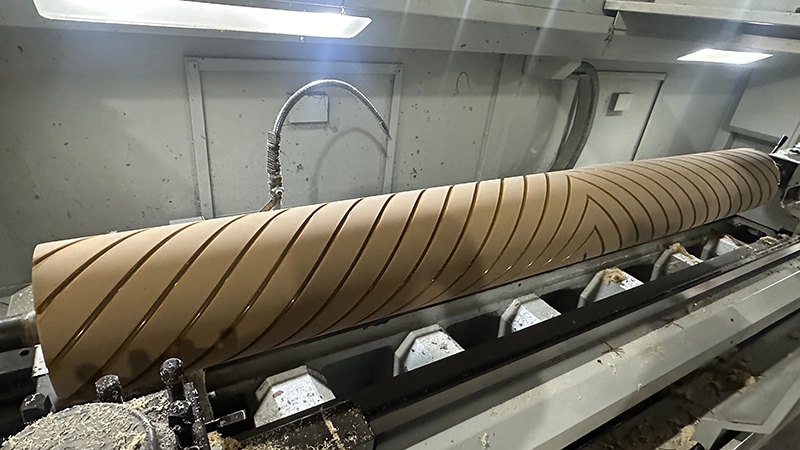
We grind rollers to precise Ra values from mirror finish to matte (Ra 1.2–3.2). We also offer spiral grooves and knurling to help expel air and improve web stability. Simply specifying diameter is not enough; target surface roughness must be clearly defined.
What is Compression Set, and why is it the "silent killer" of rollers?
Compression set is the permanent deformation remaining after a material is compressed over time. High compression set leads to flat spots after machine downtime, causing vibration, noise, and damaged product when the line restarts. It is one of the most underrated failure modes in rollers.
Cast PU typically achieves below 25% compression set under ASTM D395 through full post‑curing at 110°C for 16–24 hours. Cheap or under‑cured materials can exceed 50–60%, leading to rapid flat‑spotting. Full curing is non‑negotiable for long‑term dimensional stability.
III. Industry-Specific Applications
Which PU rollers are suitable for Cleanrooms and are "Non-marking"?
Cleanroom rollers must be non‑marking, low‑dust, and non‑outgassing. We use virgin, carbon‑black‑free white or clear polyether PU that does not leave streaks on floors. Standard black rubber or filled PU releases particles and is unsuitable for pharma or electronics cleanrooms.
Our cleanroom grades use non‑extractable catalysts to avoid microscopic outgassing. For ISO 5 (Class 100) environments, we recommend hardness of 85A or higher to reduce abrasion dust. Production is carried out in dedicated areas to prevent cross‑contamination.
What "High Rebound" PU is recommended for AGV/AMR wheels?
| Grade | Chemistry | Hardness (Shore) | Rebound (ASTM D2632) | Load Rating (@ 6km/h) | Rolling Resistance Coeff. |
| Pepsen-Vulk | NDI / PPDI | 95A | 75% - 80% | Extreme (1000kg+) | 0.012 |
| Pepsen-MDI+ | High-perf MDI | 90A-95A | 60% - 65% | High (600kg) | 0.022 |
| Standard PU | Commodity TDI | 95A | <45% | Medium (400kg) | 0.038 |
High‑rebound polyurethane lowers rolling resistance and saves battery power in AGVs. We recommend NDI or high‑performance MDI formulations with rebound resilience over 70%. Standard commodity PU only reaches 40–50%, leading to much higher energy consumption.
A 15% improvement in rebound can extend battery life by 10–15%. For large fleets, this creates massive operational savings. High‑rebound wheels also run cooler and resist heat‑related softening during 24/7 operation.
How do you prevent Solar Glass from scratching during conveyor transit?
Solar glass is incredibly sensitive; even a microscopic scratch can reduce the efficiency of the final panel. For this, we use a "Dual-Durometer" or "Micro-cellular" polyurethane. We can cast a very soft (30A-40A) PU skin over a harder 80A core. This provides the "grip" to move the glass but acts like a "cushion" to prevent any point-loading that could cause a scratch.
Additionally, we ensure the rollers are "Oil-Free." Many industrial PU formulations use plasticizers (oils) to reach low hardness. These oils can migrate onto the glass surface, ruining the subsequent coating or lamination process. Our solar-grade PU uses "reactive softeners" that become part of the chemical chain and cannot leak out. If you are seeing "ghost spots" on your glass after it passes the conveyor, your rollers are likely "leaking" low-grade plasticizers.
How does the mining industry handle "Abnormal Wear" on PU rollers?
Mining environments subject rollers to extreme abrasion, impact, and slurry. Standard PU wears out quickly. We add MoS₂ internal lubricants and tear‑resistant modifiers to improve slit‑tear strength and resistance to sharp rocks.
We also use a hard‑cap design with a 95A wear layer on the outside. This dual structure absorbs impact while resisting grinding from sand and ore. This system typically triples service life in iron ore and mineral processing applications.
Are there "Food Grade" PU rollers that meet FDA compliance?
Our food‑grade polyurethane rollers comply with FDA CFR 177.2600 using only approved raw materials, excluding harmful catalysts. They are resistant to hot water washdowns and fatty acids common in meat, dairy, and food processing lines.
Cores are 304 or 316 stainless steel to prevent rust contamination. We provide third‑party migration test reports from SGS or Intertek to verify safety. In today’s regulatory environment, self‑certification is insufficient for global food audits.
How can PU rollers reduce noise in high-speed sorting lines?
Polyurethane’s viscoelastic nature dampens vibration far better than nylon or metal. It absorbs resonant frequencies from bearings and motors, reducing overall warehouse noise significantly. This improves working conditions and helps meet urban noise regulations.
Switching to a tuned 85A PU roller typically reduces noise by 5–10 dB. We can further enhance performance with noise‑damping cavities in the metal core. This silent roller design is now standard in European logistics hubs with strict noise limits.
IV. Procurement Logic & ROI Analysis
How does the "3x Price Gap" of PU vs. Rubber rollers pay for itself?
| Metric | Standard Rubber Roller | Pepsen Cast PU Roller |
| Purchase Price (Unit) | $100 | $300 |
| Service Life | 4 Months | 24 Months |
| Replacements (2 Years) | 6 Units | 1 Unit |
| Total Purchase Cost | $600 | $300 |
| Downtime Labor Cost | $1,200 ($200 x 6) | $200 ($200 x 1) |
| Lost Production Value | $30,000 | $5,000 |
| TOTAL 2-YEAR COST | $31,800 | $5,500 (82% Savings) |
Rubber rollers cost less upfront but wear 5–10 times faster than PU. The real cost includes frequent replacements, labor for changeouts, and expensive production downtime during line stops. A small upfront saving often leads to massive hidden losses.
For a line producing $5,000 per hour, just one hour of downtime erases any price advantage of rubber. Total cost of ownership (TCO) almost always favors PU within the first year. Don’t base decisions on unit price alone—evaluate lifetime cost.
How is Tooling and Mold Amortization handled for custom rollers?
Simple cylindrical molds cost $100–200, while complex AGV or profiled molds can exceed $500. For orders over 500 units, we usually amortize mold costs into the unit price to reduce upfront capital expenditure.
For prototypes and small batches, we use CNC machining from cast billets to avoid mold costs entirely. As volume increases beyond 1,000 units, dedicated multi‑cavity molds become the most economical and consistent solution.
Should I choose "Casting" or "Injection Molding" for my ROI?
Injection molding is cheap for high‑volume consumer goods but suffers from poor creep resistance and short service life. For industrial machinery, field failures and warranty claims quickly eliminate any savings.
Cast polyurethane provides long‑term reliability and brand protection. Machines using cast rollers maintain performance for years. The cost of a single field repair can outweigh the savings of thousands of injection‑molded rollers.
What is your Factory’s Claims and Warranty policy for PU failure?
We offer a one‑year replacement warranty for material defects such as internal voids and bonding failures. If rollers delaminate or fail prematurely under proper application, we take full responsibility.
We do not cover failures caused by misapplication, such as using a dry‑environment roller in hot water. That is why we conduct a technical review before quoting. A warranty is only meaningful when the material matches the working conditions.
How do you calculate the "Downtime Cost" saved by upgrading to PU?
Downtime savings = (annual rubber changeouts − annual PU changeouts) × (labor cost + hourly production value). Reducing four changeouts per year to one can save hundreds of thousands of dollars in lost output.
Even if PU costs more upfront, the net gain is usually overwhelming. We provide a downtime calculator to help procurement teams build a data-driven case for upgrading to high-performance cast polyurethane rollers.
Do you offer B2B "Recapping" (Refurbishment) services?
We offer roller recapping for large diameters above 300mm. The metal core, which represents 60–70% of total cost, is reused if still structurally sound. We remove worn PU, re-blast the core, and re-cast a new polyurethane layer.
Recapping costs 40–50% less than new rollers and supports sustainability goals. Many heavy industry customers keep two sets of cores: one in operation, one being recapped.
V. Global Compliance & Quality Standards
Do you comply with the 2026 EU REACH Diisocyanate Restrictions?
We fully comply with 2026 EU REACH Annex XVII restrictions on diisocyanates. We use low‑monomer prepolymers with free isocyanate content below 0.1%, ensuring safe handling and regulatory compliance for EU imports.
Non-compliant material faces seizure at customs. We provide updated SDS documents confirming REACH compliance. For buyers in Germany, France, and Benelux, this documentation is now mandatory for customs clearance.
Do you have 3rd-party Lab Reports for FDA-grade PU?
We provide full third‑party test reports from SGS or Intertek for all food‑contact grades, verifying compliance with FDA CFR 177.2600 migration limits. Tests cover extraction in water and hexane to ensure no harmful substances leach into food.
Reports are updated every 24 months to reflect raw material changes. These documents are essential for HACCP and global food safety audits, replacing unreliable self‑certification.
Is your factory ISO 9001:2025 certified?
Our factory holds ISO 9001:2025 certification with strong emphasis on risk management and batch traceability. Every production run is logged with exact temperature, humidity, mixing ratio, and curing parameters.
This level of control supports a return rate below 0.5%. Customers can trace any roller back to its exact production batch. We welcome virtual and on-site audits from B2B partners worldwide.
Can you provide ESD (Anti-Static) Certification for electronics manufacturing?
Standard PU builds static electricity that damages microchips. Our ESD‑dissipative rollers use conductive carbon nanotubes or salts to achieve surface resistivity of 10⁶–10⁹ Ω, safely discharging static without damaging components.
We provide certification of conformance with point‑to‑point resistance measurements. Conductivity is homogeneous throughout the material, not just a surface coating that wears off over time.
Are TDS and MSDS documents provided with every order?
We include a full TDS and SDS (MSDS) with every shipment, covering tensile strength, elongation, tear resistance, and DIN abrasion values. These allow engineers to accurately simulate performance in CAD and FEA systems.
Documents are accessible via QR code on the product label for quick on-site reference. EHS and engineering teams require these for internal compliance and safety records.
How do you perform the ASTM D429 Bonding Test?
We conduct ASTM D429 Method E peel testing on production coupons to verify PU‑to‑metal bonding. The test measures the force required to separate the materials. Only cohesive failure—where the PU tears internally—is acceptable.
Adhesive failure indicates insufficient surface preparation or primer failure. If detected, production is halted for investigation. This destructive testing ensures no rollers with bonding risks reach customers.