



Replacing a proven imported conveyor scraper blade is rarely a matter of finding a cheaper piece of polyurethane. For one German coal mining customer, earlier lower-cost alternatives had not delivered the wear life, tear resistance or production consistency needed for continuous heavy-duty service.
The project therefore began as an engineering replacement program rather than a price-only sourcing exercise. Pepsen worked from the existing performance benchmark, developed and adjusted the polyurethane system, corrected scale-up defects during trial production, and validated the finished scraper blades before volume supply.
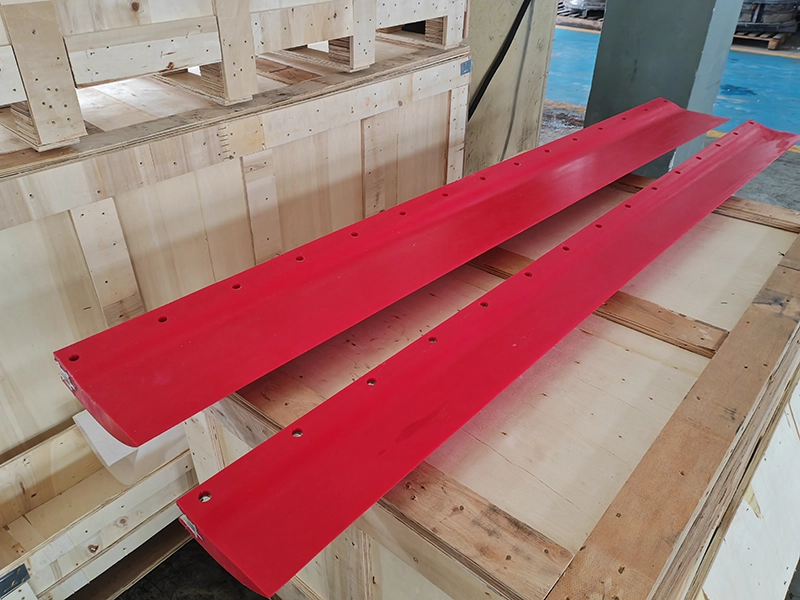
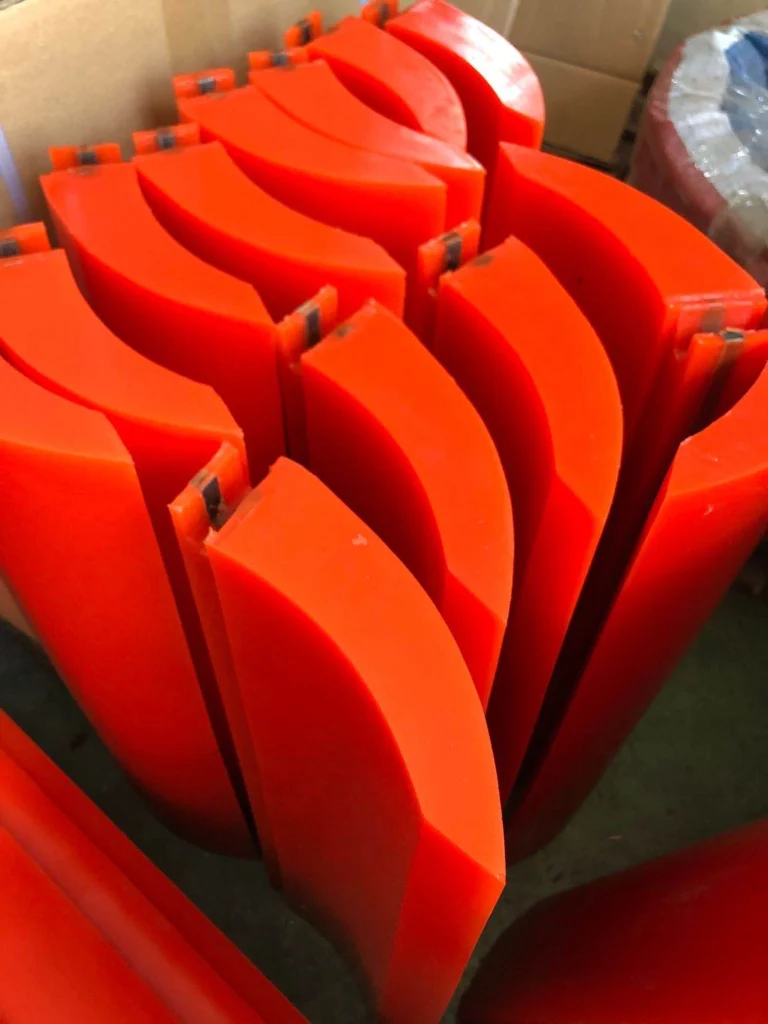
The final production lot documented for shipment comprised 150 red polyurethane scraper blades. The inspection record specified a nominal finished size of 44.5 × 181 × 2191.6 mm, Shore 80–85A hardness and 6061 aluminum metal components. After inspection and project validation, the customer moved forward with batch purchasing.
Project Snapshot
| Project Item | Documented Detail |
|---|---|
| Customer application | Coal mining conveyor scraper replacement |
| Customer market | Germany |
| Project objective | Reduce dependence on a high-cost imported scraper solution |
| Nominal finished size | 44.5 × 181 × 2191.6 mm |
| Specified hardness | Shore 80–85A |
| Metal component | 6061 aluminum |
| Documented production lot | 150 pcs |
| Validation path | Development, trial production, inspection and field evaluation |
| Commercial outcome | 65% lower overall procurement cost versus the previous imported sourcing route |
The 65% cost reduction is the documented result of this specific project and should not be interpreted as a universal saving for every conveyor scraper application. Actual economics depend on geometry, quantity, existing supplier cost, operating conditions and validation requirements.
Why the Customer Could Not Simply Buy a Cheaper Scraper Blade
The customer had long purchased conveyor scraper blades from an established international supplier. The imported products met the operating requirement, but their cost continued to increase the maintenance burden.
Lower-priced alternatives were available, but price was not the real barrier. According to the project background, conventional alternatives evaluated for this duty did not provide the required combination of:
- abrasion resistance under continuous belt contact;
- tear resistance at highly stressed areas;
- fatigue durability during repeated operation;
- stable performance in a dusty coal-handling environment;
- consistent manufacture of a scraper exceeding two meters in overall length.
This distinction matters in mining procurement. A lower unit price does not create a successful replacement if the blade wears prematurely, develops defects or requires more frequent maintenance intervention.
From Imported Blade to a Defined Engineering Specification
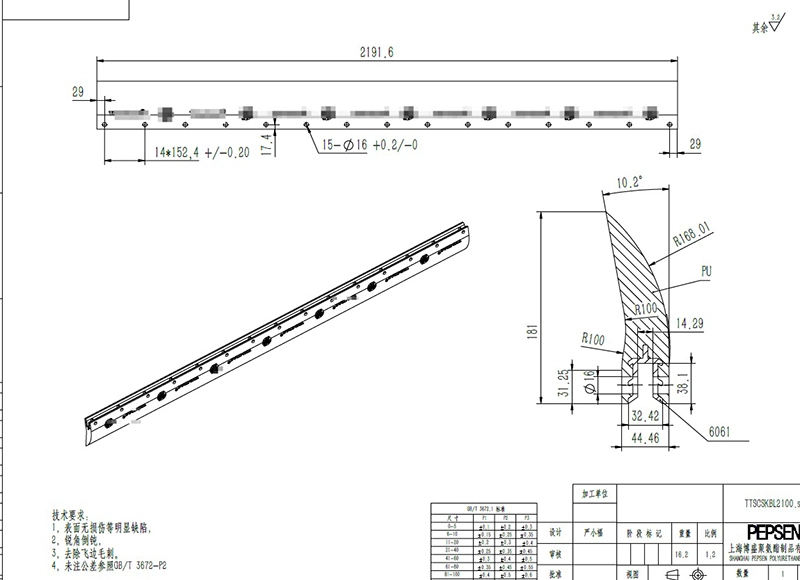
The development team first needed to turn a replacement objective into a manufacturable engineering specification. The project drawing defined the long blade geometry, mounting pattern and cross-section rather than treating the component as a generic polyurethane strip.
The drawing shows an overall length of approximately 2191.6 mm, together with repeated mounting features and a purpose-designed cross section. This was important because the development challenge involved both the polyurethane material and the repeatability of a relatively large molded component.
For similar OEM projects, Pepsen supports custom polyurethane production based on drawings, samples and application requirements. Its existing polyurethane blade manufacturing capabilities include scraper blades for conveyor belt cleaning and other industrial applications.
Material Analysis Was a Starting Point, Not the Final Answer
Because the existing imported blade had already demonstrated acceptable service performance, the team used it as a technical benchmark. Infrared spectroscopy was used during the analysis stage to study relevant characteristics of the polyurethane system and establish a more informed development baseline.
That did not mean copying a laboratory signature and assuming the job was complete. A scraper blade operating in coal handling must perform as a finished component, not merely look similar in a material analysis.
The formulation work therefore continued through multiple development rounds, with attention to key properties relevant to the failure risks identified in the project:
- 硬度 for structural support and contact behavior;
- 耐摩耗性 for continuous friction and material carryback;
- tear resistance to reduce propagation of local edge damage;
- fatigue behavior under repeated operating cycles; and
- aging stability for sustained service rather than short-term sample acceptance.
This was a balancing exercise. Increasing hardness alone does not automatically produce a better conveyor scraper. Material behavior must be considered together with blade geometry, contact conditions, mounting structure and the actual failure mode of the previous alternatives.
The Most Important Development Problem Appeared During Scale-Up
One of the strongest lessons from this project came after initial material development. During trial production, the team encountered raw-material separation and surface peeling. The issue was associated with how functional additives were introduced into the production process.
This meant that a promising formulation was still not ready for batch supply.
The technical and production teams reviewed the manufacturing sequence and repeatedly adjusted:
- the order in which materials were added;
- mixing parameters;
- handling of the functional additive system;
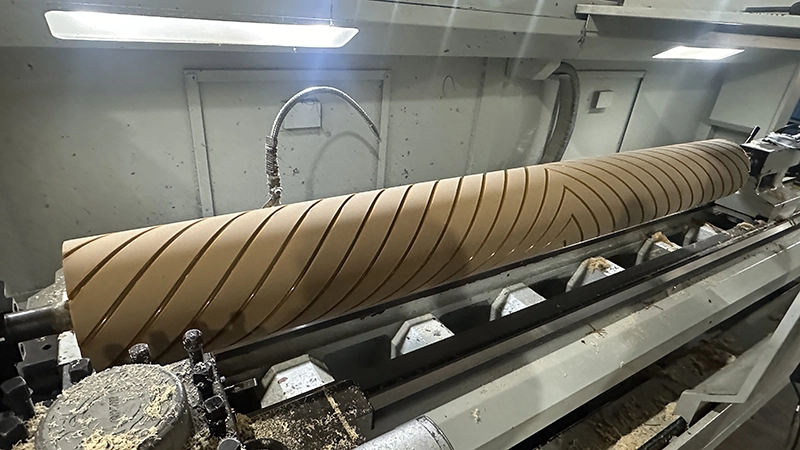
- the molding process for the large scraper component.
After multiple trial runs, the process was stabilized and the observed separation and peeling defects were resolved before volume production.
Why this matters to buyers: a supplier that can make one acceptable prototype is not necessarily ready to produce 150 consistent parts. Prototype success and repeatable batch manufacturing are separate engineering milestones.
What Was Actually Inspected Before Shipment
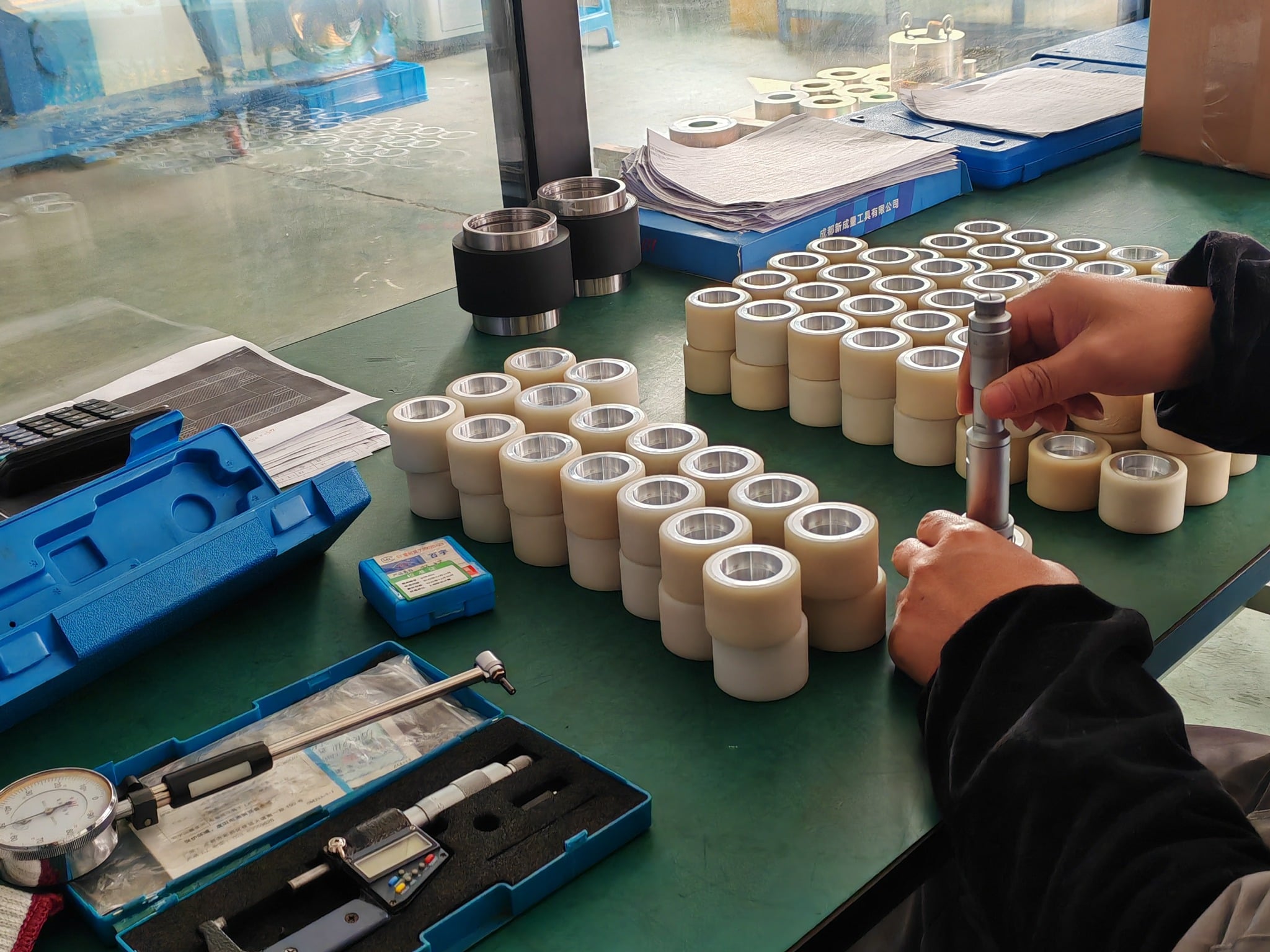
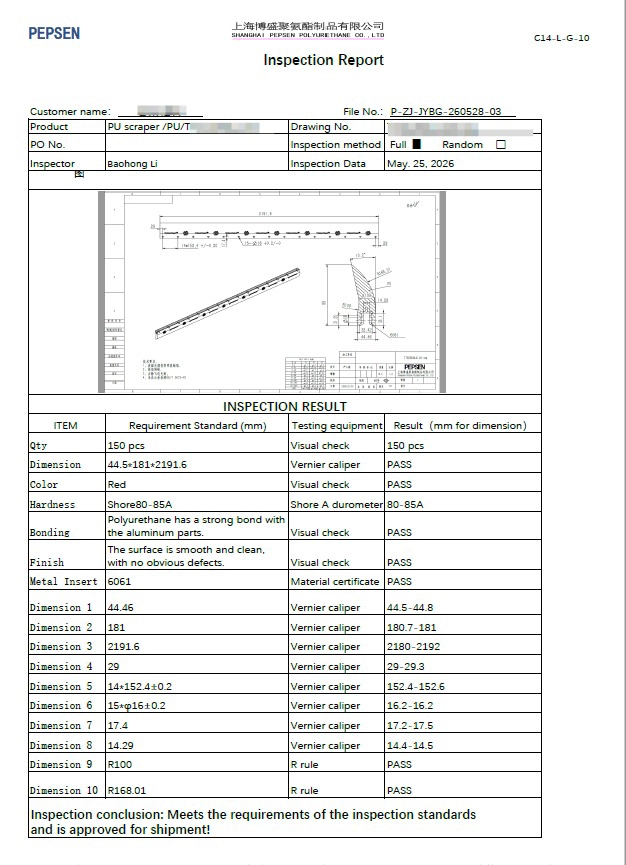
The final project was supported by a documented inspection record rather than product photographs alone. The inspection report dated May 25, 2026 covered a lot of 150 pcs and recorded checks for quantity, dimensions, color, hardness, bonding, surface finish and metal insert material.
Documented inspection items included:
| Inspection Item | Requirement / Record | Inspection Method |
|---|---|---|
| Quantity | 150 pcs | Visual check |
| Nominal size | 44.5 × 181 × 2191.6 mm | Dimensional inspection |
| カラー | Red | Visual check |
| 硬度 | Shore 80–85A | Shore A durometer |
| Bonding | Strong bond between polyurethane and aluminum components | Visual check |
| Surface finish | Smooth, clean and without obvious defects | Visual check |
| Metal insert | 6061 | Material certificate |
The report also records dimensional results for critical features rather than relying only on the nominal overall size. This is particularly relevant for a long scraper where mounting positions and cross-sectional dimensions can affect installation compatibility.
The available inspection record concluded that the lot met the inspection requirements and was approved for shipment.
From Inspection to Real Operating Validation
Passing dimensional and visual inspection was necessary, but it was not the end of the replacement program. The optimized scraper blades were sent for evaluation under the customer’s actual coal mine operating conditions.
This field stage was essential because laboratory property comparisons cannot reproduce every variable present on a working conveyor. Real performance is influenced by the conveyed material, repeated friction, installation condition, carryback, operating frequency and the interaction between the scraper profile and belt system.
According to the project record, the optimized blades performed stably during on-site evaluation and met the customer’s acceptance requirements. The customer subsequently moved to stable batch purchasing.
Commercial Result: 65% Lower Overall Procurement Cost
Compared with the customer’s previous imported purchasing route, the replacement program reduced overall procurement cost by 65%. At the same time, the validated solution achieved the service-life target required by the customer for replacement of the previous international-brand product.
The important point is that the cost reduction came after engineering development, process correction, inspection and field validation. It was not created by simply substituting a cheaper generic polyurethane blade.
| Before the Project | After Validation |
|---|---|
| Dependence on a high-cost imported scraper blade | Alternative custom supply route established |
| Lower-cost alternatives failed to meet the application requirement | Application-specific formulation and production process developed |
| Replacement risk remained high | Finished blades inspected and field evaluated |
| High procurement burden | 65% lower overall procurement cost in this project |
| No proven local replacement route | Project progressed to stable batch purchasing |
What Mining and Conveyor Buyers Can Learn from This Project
This case highlights a practical point for procurement teams considering replacement of established conveyor wear components: do not begin with “What is your price for this size?”
A more useful technical review starts with four questions.
1. Why is the current blade being replaced?
The answer may be excessive purchase cost, rapid wear, tearing, unstable quality, long lead time or dependence on a single supplier. Different problems require different development priorities.
2. What has already failed?
Previous unsuccessful alternatives are technically valuable. Their wear pattern, cracks, peeling, deformation or fatigue behavior can help identify what a new solution must improve.
3. Can the supplier scale the part consistently?
This German project showed why scale-up matters. The team had to resolve separation and peeling during trial production before the solution was ready for a 150-piece lot.
4. What evidence will support approval?
Depending on the project, this may include drawings, material targets, dimensional inspection, hardness checks, bonding review, sample approval and field testing.
Information to Send for a Custom Polyurethane Scraper Review
Pepsen manufactures custom polyurethane blades and scraper blades and supports OEM/ODM projects based on drawings, samples and working conditions. For mining applications, buyers can also review Pepsen’s polyurethane solutions for mining equipment.
For an initial scraper project review, provide as much of the following information as possible:
- 2D drawing or 3D model;
- existing blade sample, where available;
- overall dimensions and mounting pattern;
- current hardness or material specification;
- conveyed material;
- belt speed and operating schedule;
- primary or secondary cleaner position;
- temperature and moisture conditions;
- current failure mode;
- required quantity;
- target service or validation requirement.
Pepsen has specialized in custom cast polyurethane manufacturing since 2004 and supports engineering review, custom formulation, prototyping, molding, casting, machining and testing for industrial OEM/ODM parts. More information is available on the Pepsenについて page.
よくある質問
Can you manufacture a conveyor scraper blade from an existing sample?
Yes. A used or new sample can provide a starting point for geometry and material review, especially when complete drawings are unavailable. Application conditions and the failure history of the current blade should also be provided because sample duplication alone does not confirm field performance.
Is Shore hardness enough to specify a polyurethane belt scraper?
No. Hardness is only one part of the specification. Abrasion resistance, tear behavior, fatigue durability, geometry, bonding structure and actual conveyor conditions may all influence service performance. In this project, the documented hardness specification was Shore 80–85A, but the development program went beyond hardness alone.
Can Pepsen produce polyurethane scrapers longer than two meters?
This project provides a documented example of a long-format scraper with a nominal overall length of 2191.6 mm. Feasibility for other large parts depends on geometry, cross section, inserts, tolerance requirements, quantity and molding process.
How do you inspect a custom polyurethane scraper before shipment?
The inspection plan depends on the project specification. For the production lot discussed in this case, documented checks included quantity, dimensions, color, Shore A hardness, polyurethane-to-aluminum bonding condition, surface finish and 6061 metal insert verification.
Does passing factory inspection guarantee service life?
No. Factory inspection confirms whether defined manufacturing and dimensional requirements have been met. Actual service life also depends on the conveyor system, conveyed material, installation, operating conditions and maintenance. This is why the German project included field evaluation before stable batch purchasing.
What is needed to evaluate replacement of an imported scraper blade?
Provide the current drawing or sample, known material information, operating conditions, present failure mode, annual quantity and the performance target for the replacement. Where appropriate, development can proceed through technical review, prototype production, inspection and application validation before larger orders.
Discuss a Custom Conveyor Scraper Project
If you are evaluating an alternative to an imported conveyor scraper blade, send Pepsen your drawing, sample, current failure information and operating conditions. The technical team can review the geometry, hardness target, material requirements, bonding structure and production feasibility before quotation.