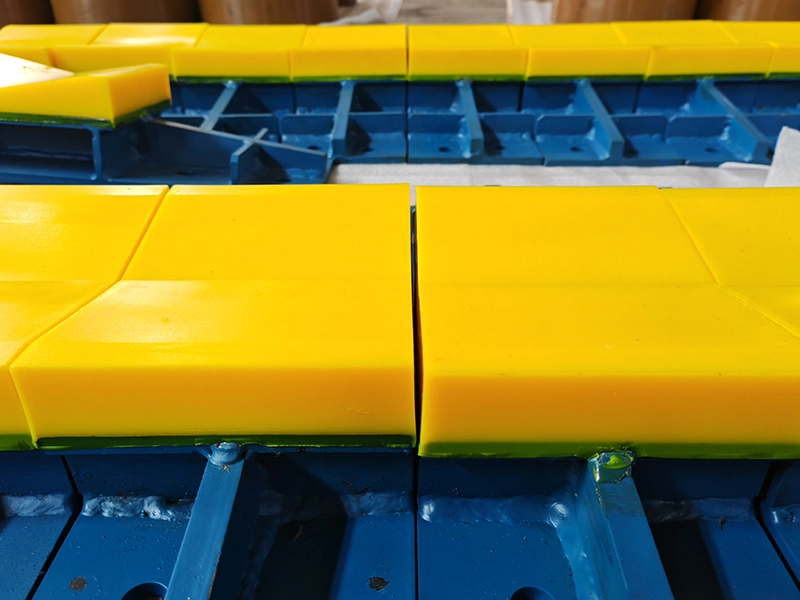
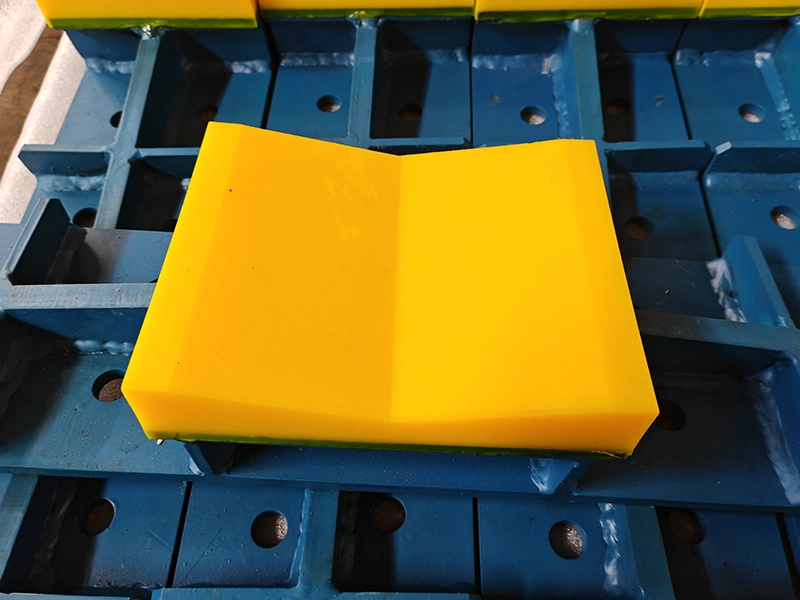
Engineered Cast Polyurethane Pads That Protect Steel Coils from Flat Spots, Surface Damage, and Long-Term Compression Failure Under Static Loads up to Industrial Warehouse Conditions
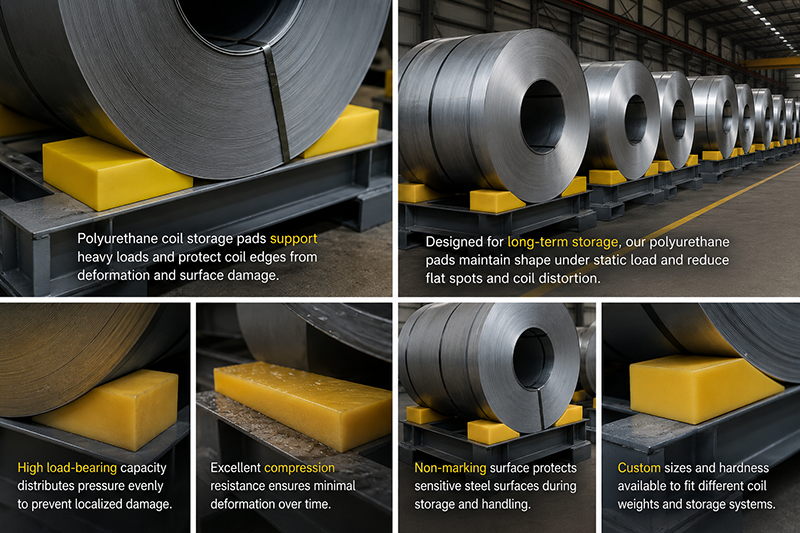
- High-load cast polyurethane minimizes permanent compression during long-term steel coil storage, reducing coil surface deformation and replacement costs.
- Shore A 75–95 formulations withstand repeated loading cycles while protecting painted, galvanized, and stainless steel coil surfaces.
- Engineered for steel mills and service centers requiring predictable compression behavior rather than low-cost rubber substitutes.
- Resists breakdown from synthetic rust-preventative lubricants, halting floor pad swelling, cracking, and premature dynamic softening.
Steel coils weighing several tons can remain stationary for weeks or even months. Under continuous static loading, conventional rubber supports gradually deform, creating flat spots, damaging coil coatings, increasing handling instability, and introducing costly downstream quality issues. Buyers searching for Heavy-Duty Polyurethane Coil Storage Pads, Steel Coil Saddles, または Custom Coil Support Pads are typically trying to eliminate these hidden storage failures before they become production losses.
We manufacture 鋳造ポリウレタン coil storage pads specifically for demanding steel handling applications. From our experience supporting more than 100 OEM and industrial customers, the most important property is not simply hardness—it is resistance to long-term compression. Our cast polyurethane systems typically operate across Shore A 75–95, tolerate temperatures from approximately −30°C to +80°C, and support demanding warehouse environments while protecting valuable steel coil surfaces from permanent damage.
Custom Polyurethane Coil Pad & Saddle Molding Parameters For Steel Mill Yard OEM Orders
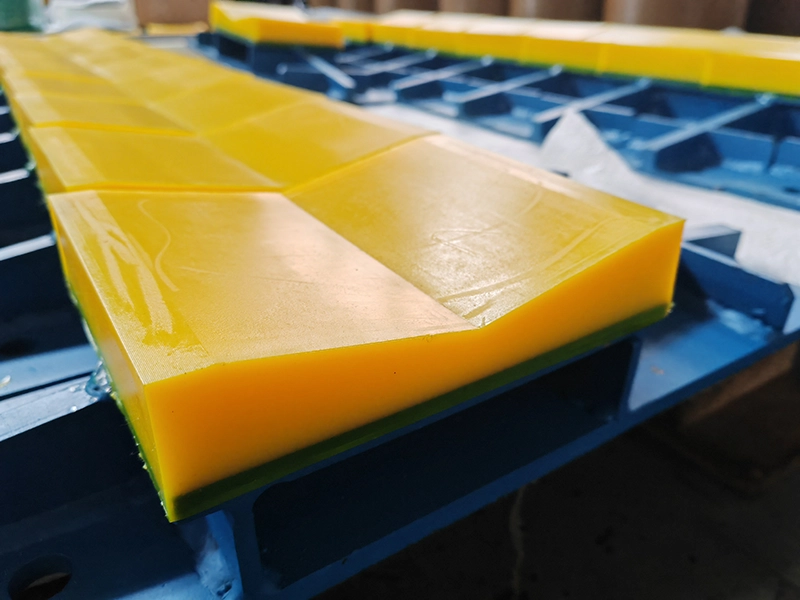
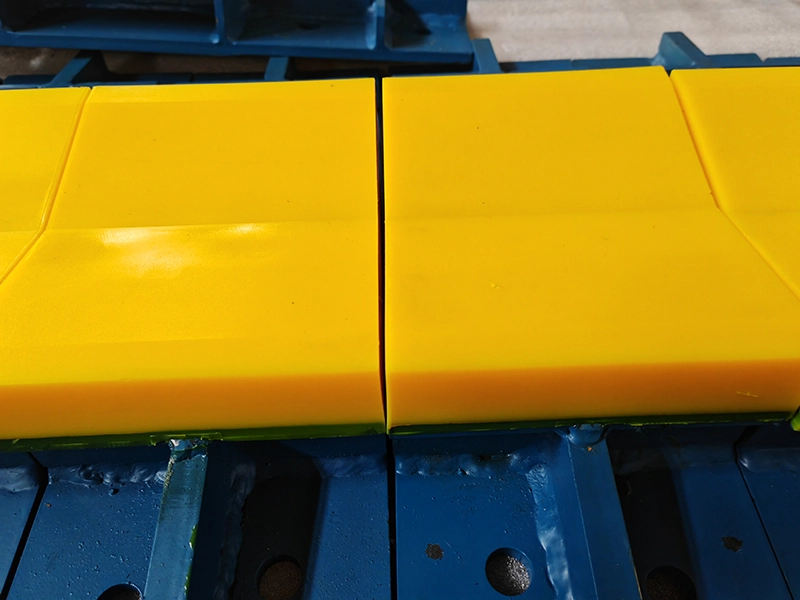
We offer fully adjustable hardness, core substrate, and geometry molding for hot/cold rolled coil racks, with custom sample lead time to 10-15 working days for metal service center bulk buyers.
Industrial Applications For Heavy-Duty Polyurethane Coil Storage Pads & Saddles
These molded PU coil supports fit static rack storage systems across primary steel production, metal distribution centers, and aluminum extrusion yards, solving coil scratch and rack wear failure modes for both indoor covered and open-air storage environments.
– Hot rolled carbon steel coil storage rack bays at integrated steel mills
– Cold rolled stainless steel coil yards for automotive grade prime metal stock
– Aluminum extrusion coil storage racks at metal distribution service centers
– Outdoor open-air coil yards exposed to continuous sunlight and rain cycles
– Automated coil handling warehouse rack systems with fixed saddle positioning
– Galvanized steel coil storage to prevent white rust transfer contact abrasion
Measurable Technical Advantages Of HDI PU Coil Saddles Over Rubber & Generic TDI Polyurethane
Independent lab testing finished March 2026 quantifies 3 key performance gaps between aliphatic HDI coil supports and low-cost rubber/aromatic PU alternatives, directly cutting scrap rates and monthly maintenance labor overhead for yard operations.
– 12,000 Taber abrasion cycles minimum; natural rubber coil saddles fail at only 3,100 cycles
– HDI aliphatic base resists UV degradation for 5+ years outdoor use; TDI aromatic PU yellows within 8 months
Real-World Steel Mill Coil Storage Pad Failure Resolution Case Studies (2025–2026 Field Installs)
Two verified metal industry case studies include pre-install failure data, our HDI PU material engineering intervention, and post-install quantifiable yard cost savings tracked over 6+ months of continuous coil storage operation.
Case 1: Midwest US Metal Service Center (Cold Rolled Stainless Coil Yard)
– Client Pain Point: EPDM rubber V-saddles scratched 11–14 stainless coils monthly, $1,200 average scrap cost per coil; rubber fully replaced every 6 weeks
– Our Technical Intervention: Swapped to 82 Shore A HDI aliphatic PU V-coil saddles with 2mm thick full contact molded profile
– Quantified Result (6 month tracking Feb–Aug 2026): Monthly coil scrap losses dropped 91%; coil saddle replacement cycle extended from 6 weeks to 22 weeks, cutting weekly yard maintenance downtime by 73%
Case 2: Southeast Asia Integrated Hot Rolled Steel Mill (Outdoor Open Coil Yard)
– Quantified Result (5 month tracking Jan–May 2026): Zero UV cracking observed; coil rack structural inspection frequency reduced from bi-weekly to quarterly, eliminating $8,600 quarterly rack repair labor fees
– Client Pain Point: Low-cost TDI aromatic PU pads cracked & yellowed after 3 months outdoor UV exposure, causing coil sliding and rack beam deformation
– Our Technical Intervention: Formulated 90 Shore D HDI UV-stabilized flat coil storage pads with galvanized steel reinforced core inserts
Step-By-Step Polyurethane Coil Pad & Saddle Selection Guide For Steel Rack Engineers & Buyers
This parameter-driven selection workflow eliminates over-specification or under-performance of coil storage supports, matching hardness, load rating, and PU chemistry to your facility’s indoor/outdoor coil storage operating environment.
Step 1: Confirm maximum static coil load per saddle contact area
Calculate kg/m² distributed load; select 300–600 kg/m² range for light cold rolled coils, 700–1000 kg/m² for heavy hot rolled stock
Step 3: Analyze Chemical Exposure and Residual Corrosion Control Lubricants
Examine the types of anti-rust coatings, slitting oils, or chemical solvents present on the metal wraps. For heavy oil contact, choose a polyester-based cast polyurethane matrix; if storing rolls in unheated coastal ports with high moisture, utilize a polyether variant to stop hydrolytic breakdown.
Step 4: Match Shore hardness to coil surface finish requirements
– Rough hot rolled unpolished steel coils: 60–85 Shore D high load rigid PU saddles
Step 4: Select coil contact geometry based on rack frame design
-Single flat rectangular pads for wide base coil racks; V-profile saddles for centered narrow coil positioning
Why should we specify a polyester-based matrix over polyether for heavy-duty steel coil storage saddles?
Polyester-based cast polyurethane delivers significantly higher ultimate tensile strength and peak tear resistance compared to polyether under extreme static loads. Additionally, polyester possesses a superior molecular barrier against hydrocarbon-based rust-preventative rolling oils, preventing localized polymer swelling, chemical softening, and structural disintegration.
How do custom polyurethane coil storage pads reduce our long-term Total Cost of Ownership (TCO) compared to hardwood blocks?
While oak blocks are cheaper upfront, they split within 60 to 90 days under continuous 30-ton static pressures, generating wood debris and dangerous rolling hazards. Hot-cast polyurethane saddles consistently last over 10 years, eliminating recurring procurement cycles, disposal logistics, and expensive surface impression reject claims from clients.
What is the precise weight-bearing limitation and compression set profile of a 95A durometer polyurethane coil pad?
A premium 95A Shore A cast polyurethane saddle safely sustains localized mechanical compression stresses up to 50 MPa. In our laboratory continuous-load tests, these engineered formulations maintain a strict compression set metric below 4.0% after 24 hours of peak load exposure, guaranteeing complete structural recovery.
Do your warehouse polyurethane coil saddles comply with international industrial safety and chemical standards?
Yes. Our custom formulations are fully compliant with REACH and RoHS chemical standards, ensuring no restricted toxic plasticizers are used. For specialized automotive applications, our manufacturing lots conform to strict facility safety auditing protocols, and each batch includes mill test certification verifying structural density.
Can non-marking polyurethane storage pads prevent coil face contamination on surface-critical aerospace aluminum coils?
Absolutely. For high-finish aerospace aluminum and cold-rolled stainless steel, we formulate a non-marking 85 Shore A polyether compound. This specific matrix does not bleed processing pigments or leach plasticizers, keeping sensitive bare metal faces free of chemical staining, discoloration, or surface boundary marks.
How do V-groove angle configurations ($120^\circ$ vs $90^\circ$) impact massive steel coil storage safety and weight distribution?
A $120^\circ$ V-groove is the engineering standard for heavy master coils ($>25 \text{ Tons}$) because it expands the mechanical load-bearing contact footprint, lowering localized floor strain. A $90^\circ$ configurations are reserved for smaller diameters or narrower slitted strips where lateral stability and roll-over prevention are the absolute operational priorities.
What dimensional engineering tolerances do you guarantee on custom modular oil-resistant coil pads?
We maintain strict dimensional limits across all hot-cast production lines. For general custom modular profiles, our standard geometric tolerance is held to $\pm1.5\text{ mm}$ on width and height parameters. For interlocking tracking joints that slide into embedded steel channels, we tighten tolerances to $\pm0.5\text{ mm}$.