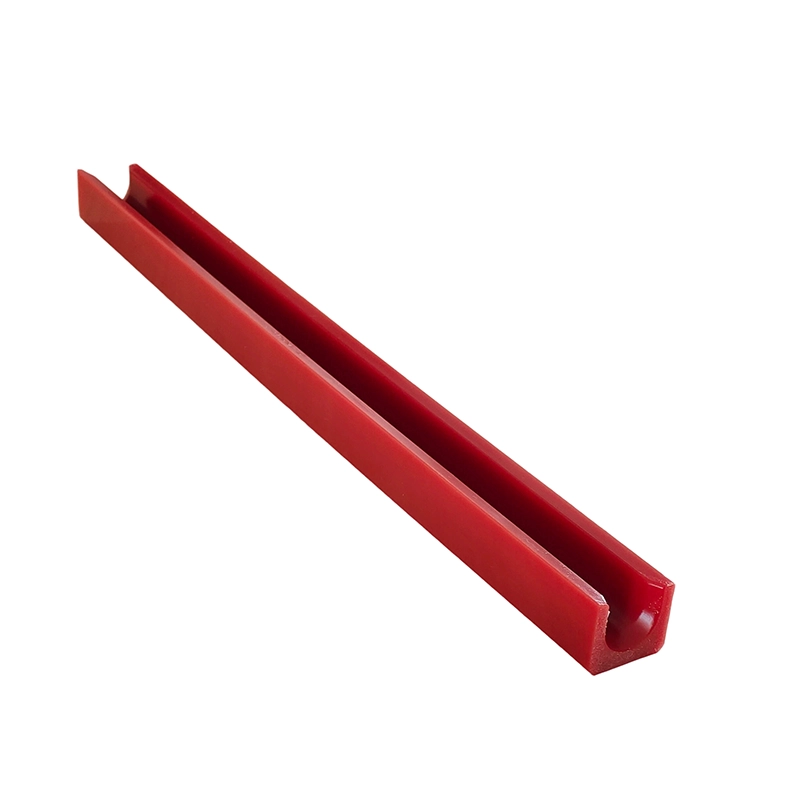
Bar feeder guide components operate in a deceptively demanding environment. Continuous bar movement, vibration, impact during loading, chips, coolant and repeated contact can gradually wear a guide channel or edge guide. Once the guide profile changes, bar alignment can deteriorate, surface damage can increase, and an inexpensive replacement component can become the cause of unplanned machine downtime. For sliding head and Swiss-type CNC equipment, the correct guide geometry matters as much as the polyurethane itself.
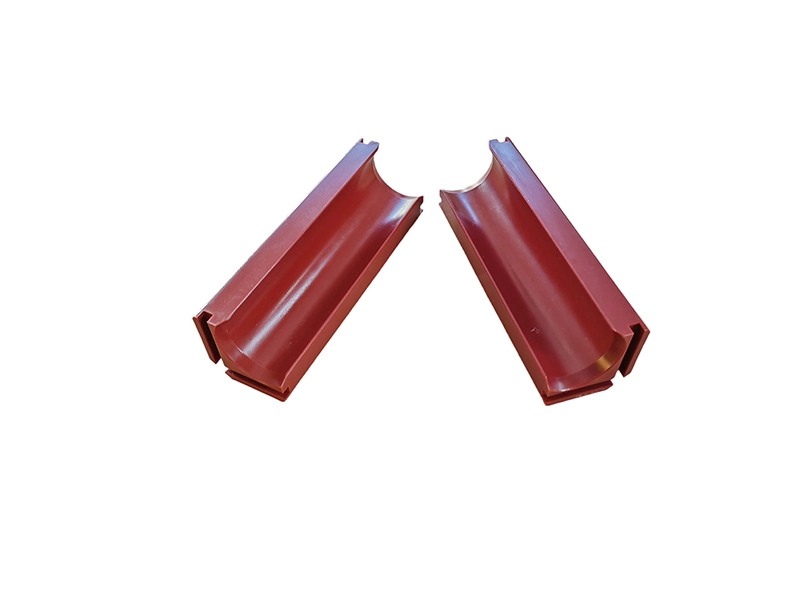
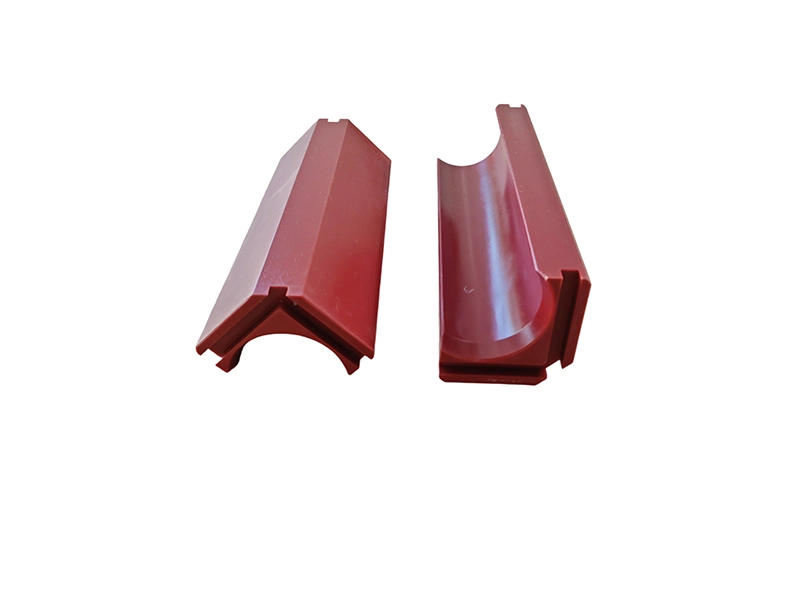
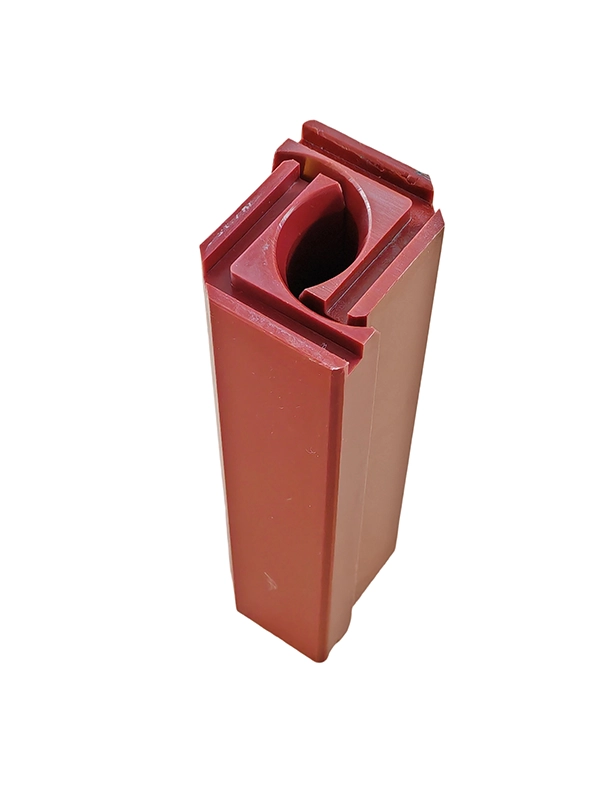
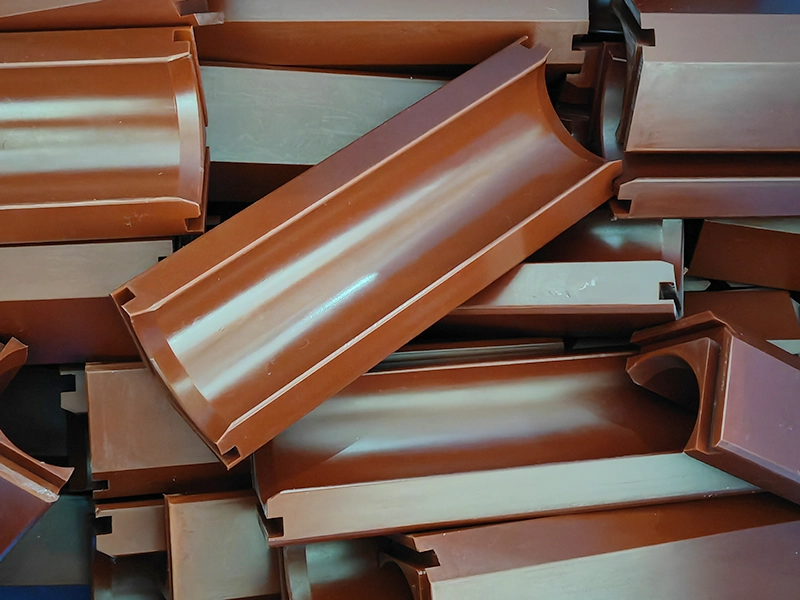
We manufacture custom PU guide channels, polyurethane guide rails and edge guides for bar feeders from customer drawings, samples or measured components. We select polyurethane hardness and geometry according to the actual contact condition rather than treating every guide as a generic 90 Shore A part. For OEM buyers, our focus is dimensional repeatability, material consistency, machinability of interfaces and predictable replacement performance.
Custom PU Guide Channel Specifications for Bar Feeders
The correct polyurethane guide is determined by the interface, load, sliding condition and machine geometry; therefore, we manufacture the component around the customer’s drawing rather than forcing a standard profile.
Custom Parameter
Typical Engineering Range / Option
Equipment & Industry Long-Tail
PU hardness
Approx. 70–95 Shore A, formulation dependent
PU guide rails for CNC bar feeders
Material
Cast polyurethane / selected PU elastomer systems
polyurethane bar feeder guide
Guide profile
Custom U, V, flat, stepped or proprietary profile
custom bar feeder guide channel
Length
According to machine assembly and drawing
long polyurethane guide rails
Width / thickness
Drawing-controlled
replacement PU guide channel
Mounting holes
Custom hole pattern, slots or inserts
OEM bar feeder guide rails
Surface finish
Molded or machined according to application
precision polyurethane guide
Tolerance
Application-specific; agreed before production
custom PU guide channel manufacturer
Contact geometry
Flat, curved, radiused or profiled
bar feeder edge guides
Temperature
Compound dependent; specify actual operating range
polyurethane guide rails for CNC
Lubrication
Dry or lubricated sliding conditions
low-friction PU guide rail
Color
Technical identification or customer specification
custom polyurethane guide
Packaging
Protective packaging for finished profiles
OEM replacement guide rails
Inspection
Dimensional and material checks according to agreed QC plan
polyurethane guide rail supplier
Industrial Applications for Polyurethane Guide Channels & Edge‑Guides on Automatic Bar Feeders
These PU guide‑rail components are drop‑in replacement wear‑parts for most popular magazine‑style bar‑feeders paired with fixed‑head and sliding‑head CNC turning‑lathes across metal‑fabrication workshops.
Typical Applications
Replacement wear‑liners for bar‑feeder series
Vibration‑damping edge guides for Iemca Boss and Master magazine feed‑units
Custom‑fit PU channel inserts for high‑speed bar‑feeders
Long‑bar support guides feeding steel, brass, aluminium and stainless‑steel bar‑stock
Spindle‑liner auxiliary guides for sliding‑head Swiss‑type automatic lathes
Polyurethane Guide Rail Advantages for Bar Feeder Applications
The main engineering advantage of polyurethane is its ability to combine elastomeric compliance with abrasion resistance, allowing the guide geometry to tolerate repeated contact without behaving like a rigid metal-to-metal interface.
– Controlled compliance — helps accommodate small alignment and dimensional variations.
– Abrasion resistance — suitable for repetitive sliding contact.
– Impact absorption — reduces the severity of intermittent loading events.
– Noise reduction — polyurethane can reduce contact noise compared with hard metallic interfaces.
– Custom hardness — allows engineers to balance stiffness and conformity.
– Complex geometry — cast polyurethane supports profiles difficult to produce economically in metal.
– Replaceable design — guides can be manufactured as maintenance components.
– Low-temperature or oil-resistant formulations — available when the operating environment requires them.
PU Guide Rail Non-Standard OEM Case Studies
The most useful comparison is not a generic material datasheet; it is whether the redesigned component addresses the actual failure mechanism while maintaining the customer’s existing mounting and machine interface.
Problem: A proprietary guide profile required replacement without changing the existing assembly.
Technical intervention: We reproduced the guide geometry from the customer’s drawing and reviewed contact surfaces, mounting geometry and polyurethane hardness before production.
Result: The replacement retained the existing installation interface, eliminating the need for an equipment-side redesign.
Engineering basis: Dimensional acceptance was treated as a drawing requirement rather than inferred from nominal hardness.
Case 2 — Sliding Head Machine Maintenance Application
Customer type: CNC machining subcontractor using sliding head equipment.
Problem: Repeated guide wear caused maintenance intervention and required replacement parts to match the original installation geometry.
Technical intervention: We evaluated the worn component, identified the contact surfaces and produced a replacement PU profile with controlled dimensions.
Result: The replacement could be installed using the existing mechanical interface without redesigning the guide assembly.
Case 3 — Material Selection
Customer type: Industrial equipment OEM.
Problem: A generic polyurethane grade was being specified solely by Shore hardness.
Technical intervention: We reviewed hardness together with contact pressure, sliding condition, temperature, contamination and geometry.
Result: The material specification changed from “90 Shore A PU” to a defined compound and application-specific hardness requirement.
This is a critical distinction: 90 Shore A is not a complete material specification.
How to Choose PU Guide Rails for a Bar Feeder
Start with the machine interface and failure mechanism, then select polyurethane hardness and geometry; choosing hardness first is one of the easiest ways to produce a technically unsuitable guide.
Step 1 — Identify the Machine
Confirm:
Bar feeder manufacturer and model.
Sliding head or fixed-head machine configuration.
Bar diameter range.
Guide channel installation position.
Existing guide drawing or sample.
Step 2 — Define the Contact Condition
Record:
Approximate contact load.
Bar diameter.
Bar material.
Feeding speed.
Sliding distance.
Lubrication condition.
Coolant exposure.
Chip contamination.
Step 3 — Select PU Hardness
As an initial engineering window:
70–80 Shore A: greater compliance and conformity.
80–90 Shore A: general-purpose engineering range.
90–95 Shore A: greater surface stiffness where geometry and loading justify it.
These are starting points, not universal recommendations.
Step 4 — Check the Geometry
Confirm:
Guide width.
Contact radius.
Groove depth.
Wall thickness.
Mounting hole position.
Fastener clearance.
Required installation interference or clearance.
Step 5 — Establish Tolerances
Do not specify unnecessarily tight tolerances on flexible polyurethane.
Instead, identify which dimensions actually control:
Most guide failures are not caused by “bad polyurethane” alone; they result from a mismatch between material hardness, geometry, contact pressure, contamination, temperature and the actual movement of the bar.
Failure Mode
Likely Cause
Engineering Response
Excessive surface wear
High sliding load or unsuitable compound
Review PU formulation and contact pressure
Edge tearing
Sharp geometry or excessive local stress
Increase radius or modify profile
Permanent deformation
Excessive compressive load or unsuitable hardness
Review hardness and section thickness
Cracking
Temperature, formulation or stress concentration
Review compound and geometry
Guide loosening
Mounting tolerance or dimensional change
Review mounting interface
Bar surface marking
Excessive hardness, contamination or debris
Review contact surface and hardness
Uneven wear
Misalignment or uneven loading
Check machine alignment
Swelling
Incompatible fluid or coolant exposure
Verify chemical compatibility
Premature failure
Wrong material selected by hardness alone
Review complete operating environment
A key engineering point
A harder PU guide is not automatically a better guide.
Increasing hardness can improve resistance to indentation in some conditions, but it can also reduce compliance with the bar and increase local contact stress. Material selection must therefore consider the complete contact system
PU Guide Channels vs. Low-Cost Alternative Materials
The correct comparison is application-specific rather than material-brand marketing: polyurethane should be selected when its combination of elasticity, wear resistance, friction behavior and custom manufacturability solves a defined mechanical problem better than the alternative.
Polyurethane vs. Rubber
PU is often preferred where greater wear resistance and controlled mechanical properties are required, while rubber may be advantageous for specific sealing, damping or chemical environments.
Polyurethane vs. TPU
TPU is a thermoplastic elastomer family, not a universal substitute for cast or specialty polyurethane systems.
For custom guide profiles, the processing method, molecular structure, hardness, formulation and operating conditions all influence performance.
Nylon can provide good stiffness and dimensional stability, but it behaves differently under sliding contact and impact.
For a guide that needs controlled compliance rather than maximum rigidity, PU may be the more appropriate engineering material.
The correct decision should be based on wear mechanism, contact pressure, coefficient of friction, temperature, contamination and dimensional requirements—not simply material price per kilogram.
Can you manufacture custom PU guide channels from our drawing or sample?
Yes. We manufacture non-standard polyurethane guide channels from 2D/3D drawings, samples, worn parts or dimensional specifications. We can customize the guide profile, length, width, bar diameter, mounting features and polyurethane hardness according to the existing bar feeder assembly.
What PU hardness is suitable for a bar feeder guide channel?
There is no single hardness suitable for every bar feeder. As an initial engineering range, 70–95 Shore A can cover many guide applications. Final hardness should consider bar diameter, contact pressure, feeding speed, temperature, lubrication and required wear behavior
What information do you need to quote a custom PU guide channel?
For an accurate quotation, send us the bar feeder brand and model, guide channel drawing or sample, bar diameter, channel dimensions, required quantity and application conditions. If the original guide is worn, photographs and measurements can also help us identify the replacement geometry.
Are polyurethane guide channels resistant to oil, coolant and abrasion?
Polyurethane can provide good abrasion resistance and resistance to many oils and industrial fluids, but performance depends strongly on the specific PU formulation and chemical exposure. For continuous coolant or oil contact, we recommend confirming the fluid type, temperature and exposure conditions before selecting the compound.
How much does a custom PU guide channel cost?
The price depends mainly on polyurethane formulation, hardness, profile complexity, dimensions, tooling, machining, quantity and inspection requirements. A non-standard guide should not be priced only by weight. Send us the drawing or sample and quantity for a project-specific quotation.
Can you produce low-MOQ or prototype PU guide channels?
Yes. For non-standard development projects, we can discuss prototype and small-batch production before volume manufacturing. This is useful when an OEM needs to verify guide geometry, installation fit, bar clearance or material hardness before committing to a larger production quantity.
How do I know when a PU bar feeder guide channel needs replacement?
Common indicators include visible wear, changes in the guide profile, increased bar vibration, scratching of the bar surface, feeding resistance, uneven wear or loss of alignment. The correct replacement decision should consider both the physical wear pattern and the machine's operating condition.
What is the difference between a standard PU guide channel and a custom OEM guide channel?
A standard guide channel is manufactured around a predefined profile and size, while a custom OEM guide channel is produced according to the customer's drawing, sample, machine interface and operating conditions. Custom production is preferable when the original component is obsolete, non-standard or no longer available.