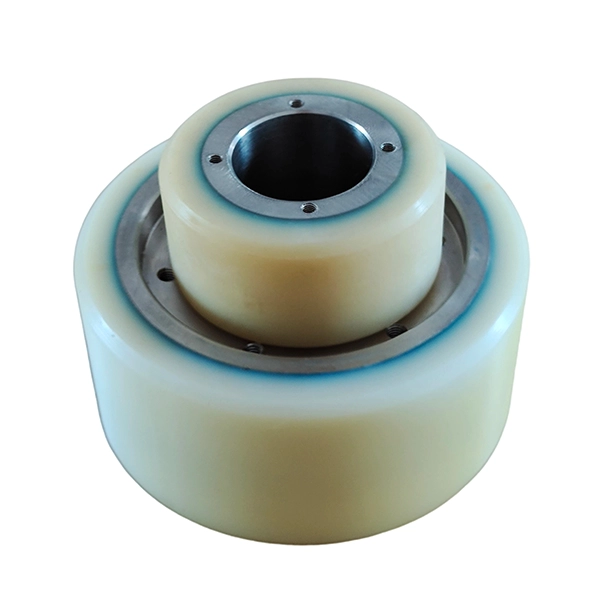
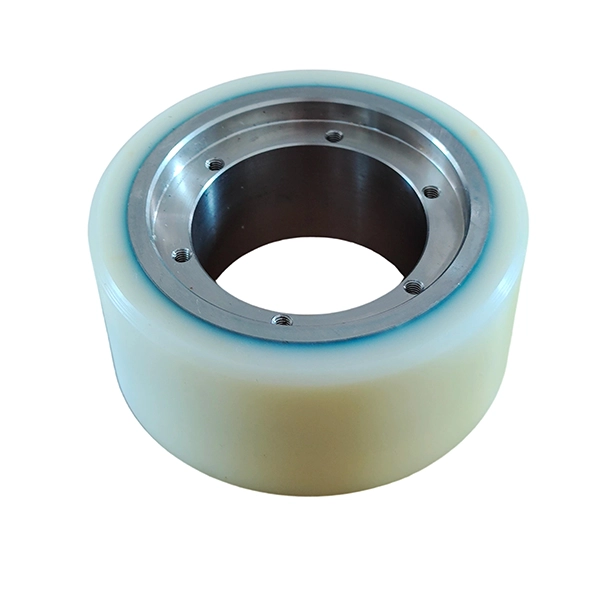
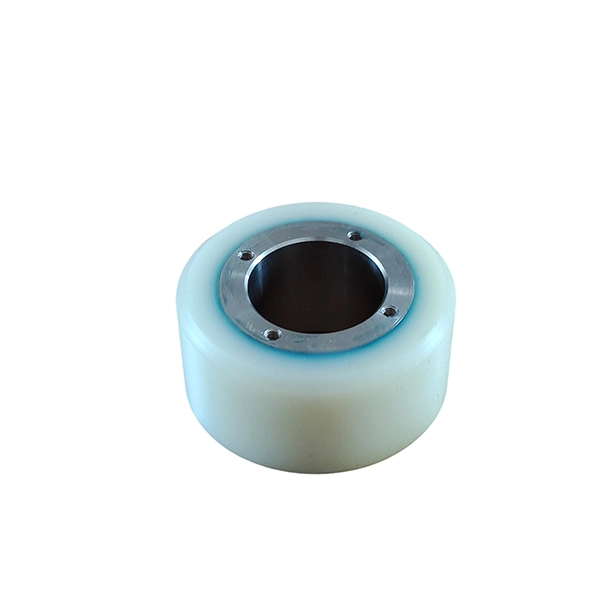
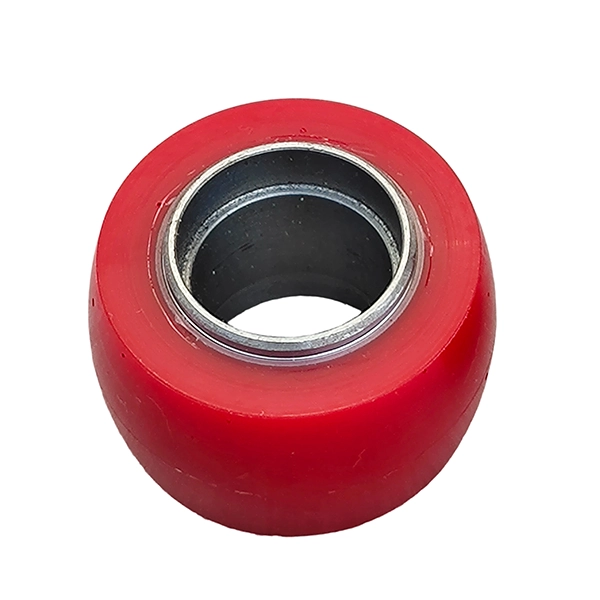
In high-speed conveyor systems and heavy-duty logistics, a single failed polyurethane roller wheel isn’t just a $50 part—it’s a catastrophic bottleneck causing thousands in hourly downtime. Most off-the-shelf TPU or rubber wheels fail within months due to “flat spotting,” thermal degradation, or the most common nightmare: debonding from the metal core. These “low-cost” alternatives drive your Total Cost of Ownership (TCO) through the roof while frustrating your maintenance teams.
We solve these failures through high-performance cast polyurethane. By integrating our 20+ years of material science, we ensure every heavy-duty polyurethane roller wheel achieves a bond strength exceeding the tear strength of the polyurethane itself (typically >50 N/mm). Whether you require high-rebound drive wheels or oil-resistant idler wheels, our polyurethane roller wheels are designed to maintain dimensional stability under loads reaching 5,000 kg per wheel.
Custom Manufacturing Options: Tailored Polyurethane Roller Wheels for Your Industry
Our custom cast PU roller wheels support tailored hardness, core materials and application-specific designs to match heavy-duty conveying, lifting and automated handling environments with precise performance control.
Core/Hub Integration: Precision bonding to Stainless Steel (304/316), Aluminum, or specialized Carbon Steel hubs with ISO-certified concentricity.
Specialized Formulations: * Hydrolysis Resistant for food processing and wash-down environments.
Our PU roller wheels serve high-load, harsh‑condition industries where rubber and TPU consistently fail, delivering stable performance in oil, moisture, heavy impact and continuous operation scenarios.
– Forklifts, pallet trucks and mobile material handling equipment
– AGV and automated guided vehicle systems in smart warehouses
– Port machinery, mining equipment and heavy-duty industrial rollers
– Textile, printing and packaging production line support rollers
Technical Specifications: Laboratory-Verified Data of Our Polyurethane Roller Wheels
We replace generic adjectives with verified physical constants. Every batch of our polyurethane roller wheels undergoes rigorous ISO testing to ensure it meets the technical demands of high-load industrial environments.
Physical Property
Value (Typical 95 Shore A)
Client Benefit
Tensile Strength
45.5 MPa
Prevents tread cracking under high torque
Tear Strength (Split)
92 kN/m
Resists gouging from floor debris
Compression Set
18%
Eliminates “flat spotting” after static load
Elongation at Break
450%
Superior impact absorption & flexibility
Bond Strength to Steel
>55 N/mm
Zero debonding; PU tears before bond fails
Performance Benchmark: Why Polyurethane Roller Wheels Outperform Rubber and Nylon
Selecting the wrong material leads to premature failure. Our polyurethane roller wheels offer the high load capacity of nylon without the brittle failure, and the grip of rubber without the rapid abrasion.
Performance Metric
Cast Polyurethane (Pepsen)
Industrial Rubber
Standard Nylon
Abrasion Resistance
★★★★★ (High)
★★☆☆☆ (Low)
★★★★☆ (Medium)
Load Bearing Capacity
★★★★★ (Max)
★☆☆☆☆ (Weak)
★★★★★ (High)
Noise Damping (<75dB)
★★★★☆ (Excellent)
★★★★★ (Best)
★☆☆☆☆ (Poor)
Chemical/Oil Resistance
★★★★★ (Superior)
★☆☆☆☆ (Poor)
★★★★☆ (Good)
Floor Protection
★★★★★ (Non-marking)
★☆☆☆☆ (Marking)
★★☆☆☆ (Harsh)
PU Roller Wheels Application Cases
From automotive conveying to warehouse AGVs, our custom solutions resolve frequent wheel replacement and downtime issues with measurable performance improvements and extended service life.
– Automotive Conveyor Manufacturer
Pain point: Rubber rollers wore out in 45 days, causing frequent line stops.
Our solution: 92 Shore A cast PU rollers with bonded steel cores.
Result: Service life extended to 180 days; downtime reduced by 72%.
– Warehouse AGV System Integrator
Pain point: TPU wheels cracked under 500 kg dynamic loads.
Our solution: High-resilience cast PU formulation with 58 kN/m tear strength.
Result: Zero cracking failures over 12 months of continuous operation.
– Heavy-Duty Pallet Truck Supplier
Pain point: Low-grade PU delaminated at high turning speeds.
Our solution: Thermally bonded core technology with strict curing control.
Result: Delamination eliminated; replacement cycle increased by 300%.
Correct wheel selection depends on load, speed, environment and material compatibility; our step-by-step guide ensures you choose optimal parameters to avoid premature failure.
Step 1 – Determine Dynamic Load Requirement
Light load (<200 kg): 75–85 Shore A PU
Medium load (200–500 kg): 85–92 Shore A PU
Heavy load (>500 kg): 92–98 Shore A high-density cast PU
OEM: Custom logo, dimension and packaging available
PU Roller Wheels Common Failure Modes & Prevention
Most wheel failures stem from poor casting, weak bonding or incorrect hardness; our engineering eliminates these root causes to ensure stable long-term performance.
– Delamination
Cause: Inadequate core treatment or improper curing.
Our solution: High-modulus cast PU for stable dimensional performance.
– Chemical Degradation
Cause: Standard PU in oil/chemical environments.
Our solution: Oil-resistant grade for industrial fluid exposure.
What Shore A hardness is best for polyurethane roller wheels?
Most applications perform best with 90A–95A Shore hardness. For heavy-duty and high-abrasion scenarios, 95A–98A is recommended, while softer 80A–85A is used for quiet running and delicate floor protection.
Are polyurethane roller wheels non-marking and oil resistant?
Yes, our polyurethane roller wheels are non-marking and offer excellent oil, grease, and chemical resistance. They leave no stains on floors and perform reliably in industrial environments with lubricants.
What load capacity can polyurethane roller wheels support?
Load capacity depends on size and core material, ranging from 50kg to 5,000kg per roller. Heavy-duty models with steel cores can handle extremely high loads for material handling and conveyor systems.
Can polyurethane roller wheels be used outdoors and in wet environments?
Yes, they can be used outdoors and in wet conditions. Our PU formula offers good water and weather resistance, though extended exposure to strong UV may require a UV-stabilized grade for long outdoor service life.
Do you provide food-grade polyurethane roller wheels with FDA approval?
Yes, we offer food-grade polyurethane roller wheels that comply with FDA standards for food processing, packaging, and beverage industries, safe for indirect food contact.
What core materials are available for polyurethane roller wheels?
Common core options include steel, stainless steel, aluminum, and nylon. Steel cores are used for heavy loads, aluminum for light weight, and stainless steel for corrosion-resistant or food-grade applications.
What is your MOQ for polyurethane roller wheels?
We accept flexible MOQs. For standard sizes, MOQ starts at 50–100 pieces. For fully custom molds, MOQ is generally 300–500 pieces depending on product dimensions.
How do you monitor the production process to avoid delayed delivery?
We use the ERP system to execute orders, and can check the order status and expected delivery time at any time.
What is warranty of products?
All of products with 3-6 months guarantee (except very frequently wearing parts).
How do you deal with after sales service?
We will response in 24 hours with solutions such as replacement or reworking.