




Our TDI and NDI Based Polyurethane Pass FDA Testing: Enhanced Wear Resistance, Flame Retardancy and Anti-Static Performance
Choosing the Right Cast Polyurethane System: TDI vs NDI for Industrial and Food Contact Applications
When engineers search for a custom polyurethane manufacturer, the first questions are usually not about appearance or price.
They need clear answers:
- Can the polyurethane material pass FDA requirements?
- Which chemistry is better for my application, TDI or NDI?
- How long will the polyurethane component last under abrasion?
- Can polyurethane parts prevent static accumulation or improve fire safety?
- What hardness and mechanical properties should be selected?
MDI is widely adopted as raw material for FDA-qualified polyurethane. However, it comes with clear limitations. It brings difficulties in processing and operation. Meanwhile, MDI is demanding in storage. It reacts easily with moisture in the air, which leads to material degradation. Strict temperature and moisture isolation measures are mandatory throughout storage, adding extra complexity to the whole production chain.
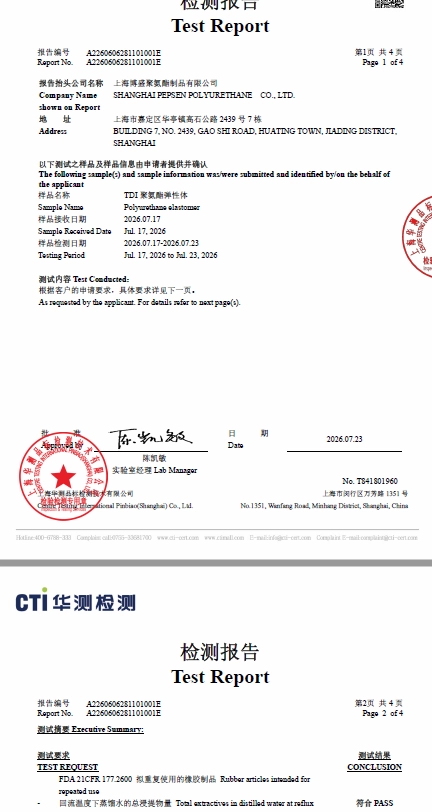
その後 passing FDA testing with MDI-based polyurethane last year , we make another breakthrough this year.
Based on 20 years of cast polyurethane elastomer manufacturing experience, we developed two functional material systems to solve these engineering requirements:
- TDI-based cast polyurethane with enhanced abrasion resistance
- NDI-based cast polyurethane with flame retardant and anti-static performance
Both systems have successfully passed FDA testing requirements, providing reliable material options for industrial equipment manufacturers and application engineers.
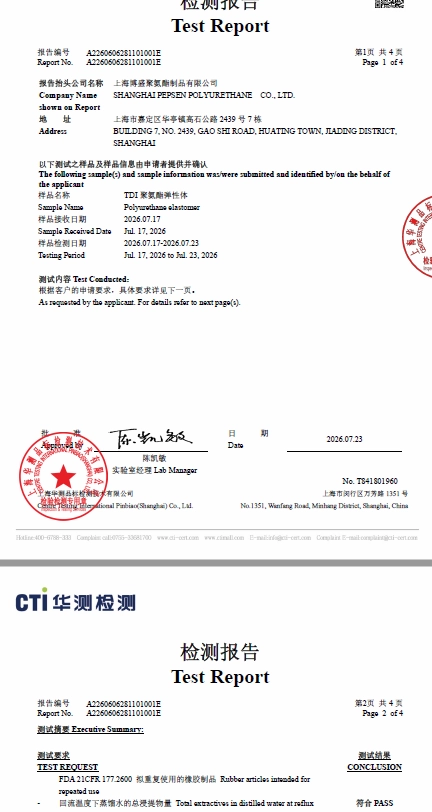
Why FDA Testing Matters for Cast Polyurethane Components
For equipment manufacturers supplying food processing, packaging, pharmaceutical, and clean production industries, material compliance is a critical purchasing factor.
Polyurethane components may directly contact:
- Food conveying systems
- Processing equipment
- Packaging machinery
- Automated handling systems
FDA testing evaluates whether the polyurethane formulation meets safety requirements for specific contact applications.
Our approach is different from simply selecting a standard polyurethane grade.
We control:
- Polyurethane chemical structure
- Raw material purity
- Additive selection
- Curing process
- Final mechanical performance
This allows us to develop FDA-tested cast polyurethane elastomers while maintaining industrial durability.
TDI Cast Polyurethane with Wear-Resistant Formula: Designed for High Abrasion Applications
TDI polyurethane systems are commonly selected when equipment requires:
- High abrasion resistance
- Good elasticity
- Impact absorption
- Cost-effective customization
However, ordinary polyurethane formulations may experience accelerated wear under continuous friction.
To solve this problem, we introduced a specialized wear-resistant additive package into our TDI cast polyurethane system.
The purpose is not simply increasing hardness, but improving the balance between:
- 耐摩耗性
- 引裂強度
- Elastic recovery
- 動的疲労特性
Typical applications include:
- Polyurethane conveyor rollers
- Industrial wheels
- Mining wear liners
- Material handling components
- Protective pads
Typical Physical Properties of Our Wear-Resistant TDI Polyurethane
| 比較項目 | Typical Value |
|---|---|
| 硬度 | 75–95 Shore A |
| 引張特性 | 25–45 MPa |
| 引裂特性 | 60–100 kN/m |
| 動作温度 | -40℃~+80℃ |
| 摩耗損失 | Controlled according to formulation |
For high-cycle applications, abrasion resistance is usually more important than hardness alone.
A 95 Shore A polyurethane is not automatically more wear-resistant than an 85 Shore A material. Polymer structure, cross-link density, and additive selection determine actual service life.
NDI Cast Polyurethane with Flame Retardant and Anti-Static Performance
When should engineers choose NDI polyurethane?
NDI polyurethane systems are preferred for applications requiring:
- Long-term mechanical stability
- Low compression set
- High load resistance
- Extreme durability
For safety-sensitive environments, we modified the NDI formulation by adding:
1. Flame Retardant Additives
The flame retardant system helps improve polyurethane fire safety characteristics when components operate near heat sources or in regulated environments.
Typical applications:
- Mining equipment(Polyurethane Friction Drive Wheels for Mining Crane Suspended Monorail Systems )
- Industrial conveyors
- Electrical manufacturing equipment
- Safety protection components
- Heavy Duty PU Wheels for Port Machinery
2. Anti-Static Additives
Static electricity accumulation can create problems in:
- Electronics manufacturing
- Dust-sensitive environments
- Automated production lines
Our anti-static polyurethane formulation reduces surface resistance and helps control electrostatic charge generation.
Typical electrical performance:
| 比較項目 | Typical Value |
|---|---|
| Surface Resistivity | 10⁶–10⁹ Ω |
| 硬度 | 70-95ショアA |
| 使用温度 | -40°C~+120°C |
TDI vs NDI Polyurethane: How Should Engineers Select the Right Material?
Many purchasing teams ask:
“Should we choose TDI or NDI polyurethane for our component?”
The answer depends on operating conditions.
| Requirement | Recommended System |
|---|---|
| General industrial wear resistance | TDI polyurethane |
| Cost-sensitive high abrasion parts | TDI polyurethane |
| Long-term mechanical stability | NDI polyurethane |
| Anti-static requirement | Both available |
| Flame safety requirement | Both available |
| FDA-tested application | Both available |
Material selection should always consider:
- 負荷周波数
- Contact pressure
- 使用温度
- Chemical environment
- Safety requirements
Our Cast Polyurethane Manufacturing Process Controls Material Consistency
For industrial buyers, material consistency is often more important than laboratory peak performance.
Our quality control process includes:
Raw Material Inspection
We check:
- Isocyanate properties
- Polyol characteristics
- Additive compatibility
Production Control
We monitor:
- Mixing ratio
- Casting temperature
- Curing time
- Post-curing conditions
Final Testing
Each production batch can be evaluated through:
- Shore hardness testing
- Tensile strength testing
- Compression set testing
- 寸法検査
- Surface quality inspection
This process helps ensure customized polyurethane components maintain stable performance during actual operation.
Supporting Global OEM Customers with FDA-Tested Custom Cast Polyurethane
Selecting polyurethane material is not only a purchasing decision.
It directly affects:
- Equipment downtime
- Maintenance frequency
- Production efficiency
- Safety compliance
Our FDA-tested TDI and NDI cast polyurethane systems provide engineers with more options:
- Wear-resistant polyurethane for heavy-duty equipment
- Flame-retardant polyurethane for safety applications
- Anti-static polyurethane for controlled environments
- Custom cast polyurethane parts for OEM requirements
With 20 years of polyurethane engineering experience, we continue improving material formulations based on real operating conditions, not only laboratory specifications.